Breakthrough: Radical New AI Hardware Design That Nvidia Can’t Ignore | COSM 2025 – “There is no more bussing data back-and-forth to from memory; instead, it’s all done within the same device: computation and memory within the same device [and made on existing CMOS processing lines with no exotic materials or unduly requirements].” 11:30 in
Funny how humanity started with magnetic-core memory mesh, and its seems we have come full-circle LOL
RE electromagnetic interference question at 13:30 — It will not matter because the mumetal shielding can be easily applied just as anywhere. There is likely no benefit over nor shortcoming under existing electronics.



https://jesusandscience.org
Transcript
Click to reveal
So what I'm going to introduce today is
0:07
something that this is the first time
0:10
I'm speaking about it publicly. It's a
0:12
it's a new design for AI computation and
0:17
uh it addresses one of the biggest
0:18
challenges that we've been hearing about
0:21
which is the energy requirements and to
0:24
really lower the energy and uh not all
0:28
the details are going to be in in here
0:32
but but enough for you to get the
0:33
concept. uh the the patents still have
0:36
not not uh uh gone public. So we're
0:39
still not revealing uh uh the details of
0:42
this and uh uh so this is an effort
0:45
that's been going on in my group for for
0:49
about a year and a half and and the the
0:52
story behind it is is when Nvidia really
0:56
just burst on the scene about a year and
0:58
a half ago. I brought in uh one of the
1:01
guys in my group who works in in in
1:03
device architectures and I said, "Look,
1:06
we we we've got to we've got to get in
1:08
on this. We've got to do something in
1:10
AI." Uh but we're not a software group.
1:13
We've got to do it differently. I want
1:15
you to design a new hardware system. And
1:18
uh um he said, "That's very hard." I
1:20
said, "That's exactly why I'm asking you
1:22
to do this because we we do it as
1:25
President Kennedy said, we're doing it
1:27
because it is hard." And after 6 months
1:30
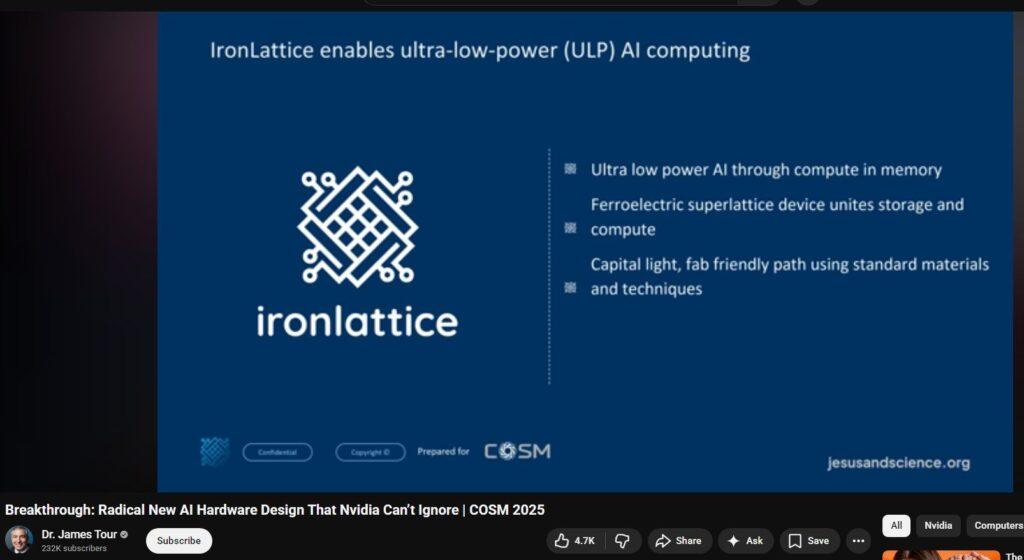
he came up with something. This is ultra
1:32
low power to compute in memory. So what
1:35
happens now is when you do computation
1:37
you actually actually are um you you
1:41
move you move uh information from the
1:43
logic to the memory back and forth. You
1:47
do a logic and then you move it back and
1:49
you bus it back and forth. And this is
1:51
this takes a lot of energy to do this.
1:53
And this is a compute in memory system
1:55
where the same device does the memory
1:57
and the computation and it's based on a
2:00
ferroelectric super lattice and it's
2:02
capital light. There's no exotic
2:04
materials in here. There's no graphine
2:06
in here, no exotic materials. It works
2:08
on a standard CMOS line and can
2:11
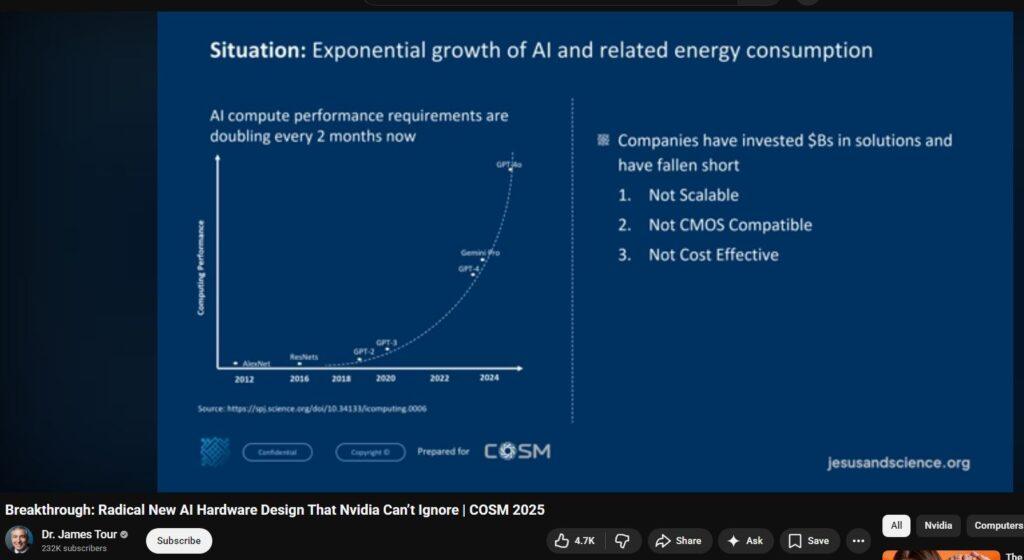
translate just like that. So if we look
2:13
at at at the this exponential growth in
2:15
AI that we've been talking about and you
2:18
see this this uh uh what's happening
2:20
here and companies are investing
2:22
billions of dollars and and I just heard
2:24
one one recent company is $150 billion
2:27
committed to their data centers. Uh uh
2:31
the the thing is that that they're often
2:33
not scalable. They're not cos compatible
2:36
and they're not cost effective. So we
2:38
had to address this. And so the idea is
2:40
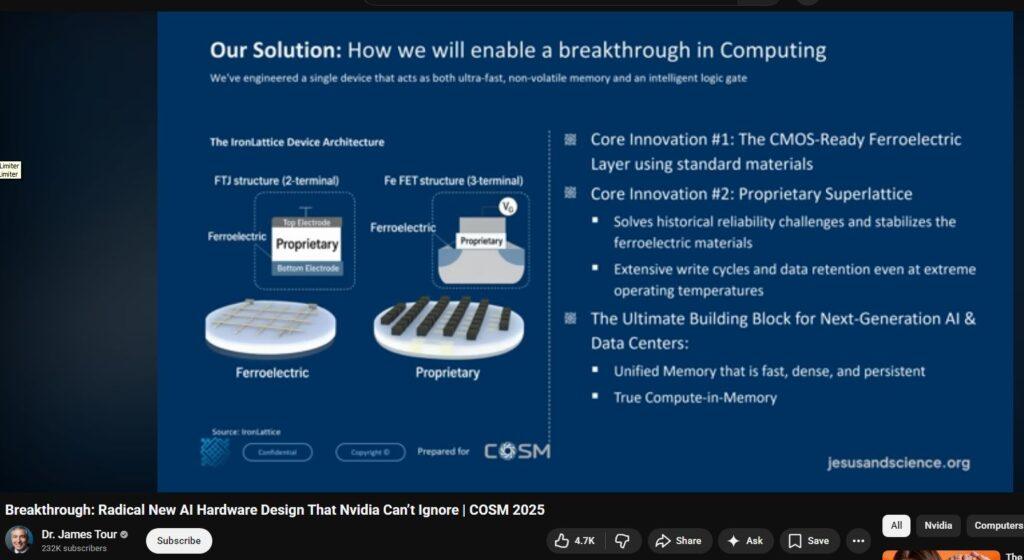
that we would enable this and we'd come
2:42
up with a core innovation. It's a cos
2:45
ready ferroelectric layer. Works on a
2:47
normal processing line, normal
2:49
fabrication line. It's a proprietary
2:51
super lattice. It solves the historical
2:53
reliability challenges. There's these
2:56
extensive write cycles and data
2:58
retention even at extreme operating
Energy & speed benefits vs NAND/DRAM
3:00
temperatures. We've demonstrated uh it's
3:03
the ultimate building block and that and
3:04
we'd truly like to do this compute
3:06
computation in memory all in one device
3:10
and so our way of of thinking about how
3:13
we would introduce this to the market is
3:15
to just just look at it initially as a
3:18
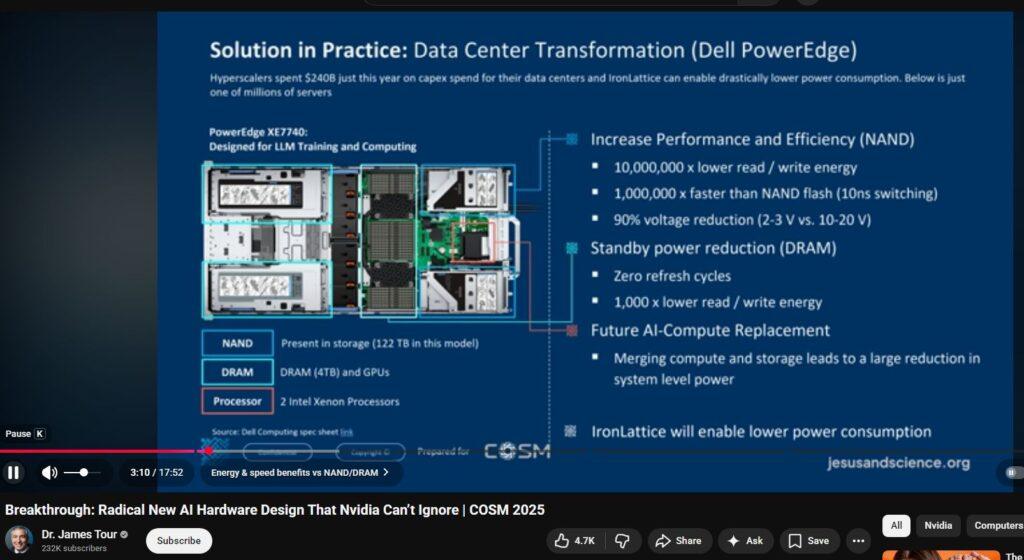
memory system. So if if you look at this
3:20
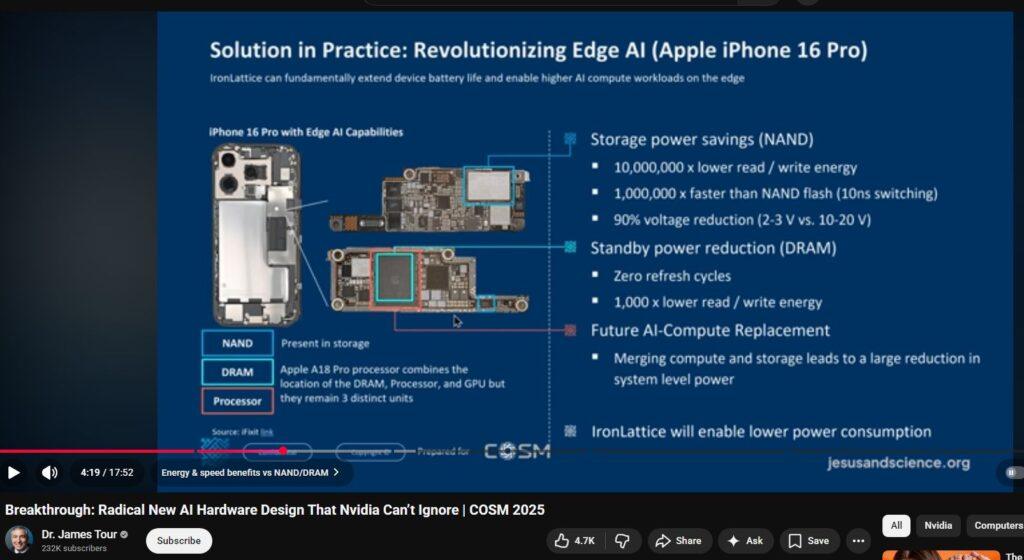
we are about 10 million times lower read
3:24
write energy than NAND flash. uh were
3:28
about a million times faster than nan
3:31
flash and about 90% voltage reduction
3:34
than nan flash. Uh if we compare it to
3:38
DRAM we it's nonvolatile so we'll have
3:41
zero refresh cycles. It's about a
3:43
thousand times lower read write energy.
3:46
And so what we would think of doing is
3:48
is first switching out just if if this
3:50
were a data center uh uh system that we
3:54
would initially switch out the NAND
3:56
systems. we could start making money
3:58
that way without having to rewrite
4:00
software without having to to do
4:01
anything much here and then we would
4:03
start switching out the the DRAM again
4:06
moving into that market and then do the
4:09
full uh uh compute in memory that's
4:12
that's what we have uh uh thinking about
4:14
how we would do this and introduce it
4:17
you could do the same thing even in a
4:19
smartphone again just initially
4:21
switching out the NAND the flash memory
4:24
and then moving into the DRAM system and
4:27
then moving into the compute because if
4:29
if there are companies that are going
4:31
directly to to try to do the compute and
4:34
memory compute and memory but it's hard
4:36
to get this introduced into the market
4:39
that way. So that that's the plan of
4:41
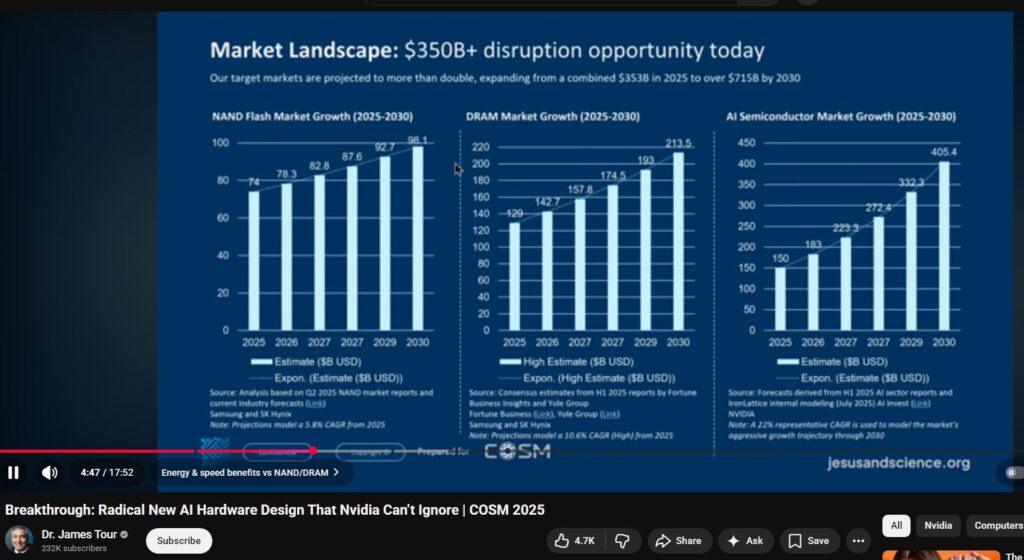
doing it this way. And so if you look at
4:43
the the growth of NANFL flash, you know,
4:45
it's a healthy growth on NAN flash,
4:47
healthy growth on DRAM, and of course
4:49
then the AI semiconductor market. So
4:52
huge areas of growth here that we would
4:54
be able to capitalize upon that we would
4:56
try to do. If you do not believe in the
4:58
physical resurrection of Jesus Christ,
5:01
send me an email tour.org
5:05
or and we will get together and I will
5:08
share with you about why I embrace the
5:10
resurrection of Jesus. We want to derisk
5:13
this again this this pathway to just
5:15
have this drop in CMOS compatible proven
5:19
materials standard equipment. There's no
5:21
no unusual tools that we even need for
5:23
this. We we're we're building this
5:25
straight on a on our university uh
5:28
system with with uh all the standard
5:30
tools. We are technology ready readiness
5:33
level TRL4 again which is just a
5:36
component validation in a lab
5:38
environment. We have not yet moved this
5:40
into a foundry. We're talking with
5:41
several of the the the classic
5:43
foundaries to to be able to do this. Our
5:46
strategy is to be capital light would be
5:48
a fab fabulous bu business model uh tier
5:51
one R&D partners and we'd secure US
5:54
production to follow. Uh this is some of
5:57
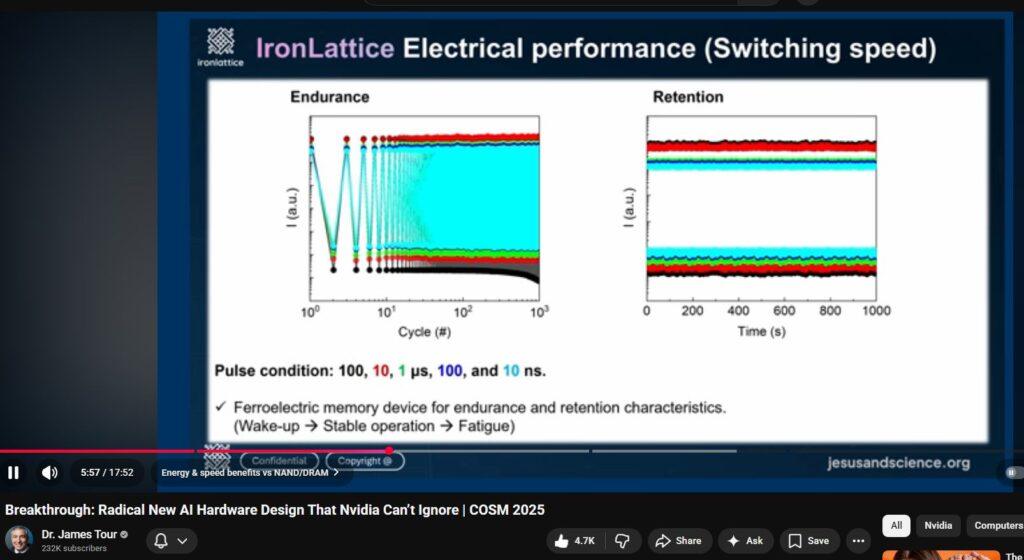
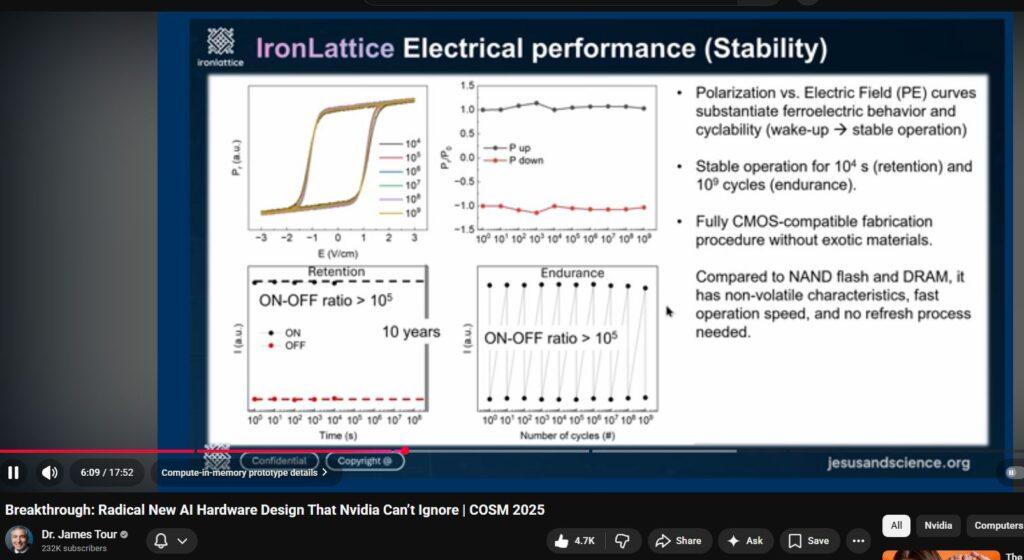
the endurance. I've I've intentionally
5:59
kept off here the scale, but you can see
Compute-in-memory prototype details
6:01
that this is a logarithmic scale here.
6:03
And these are the cycle numbers, the
6:05
endurance, and the retention.
6:08
And uh uh we look at at the electrical
6:11
performance, the stability. So these are
6:13
the the polarization curves uh that
6:15
we've got here and and uh uh how we've
6:18
been able to do this this computation
6:20
and and uh uh trying to extrapolate this
6:23
out. Um we we still have to get this up
6:25
to the the required 10 to the 12th
6:28
cycles and eventually hopefully even
6:30
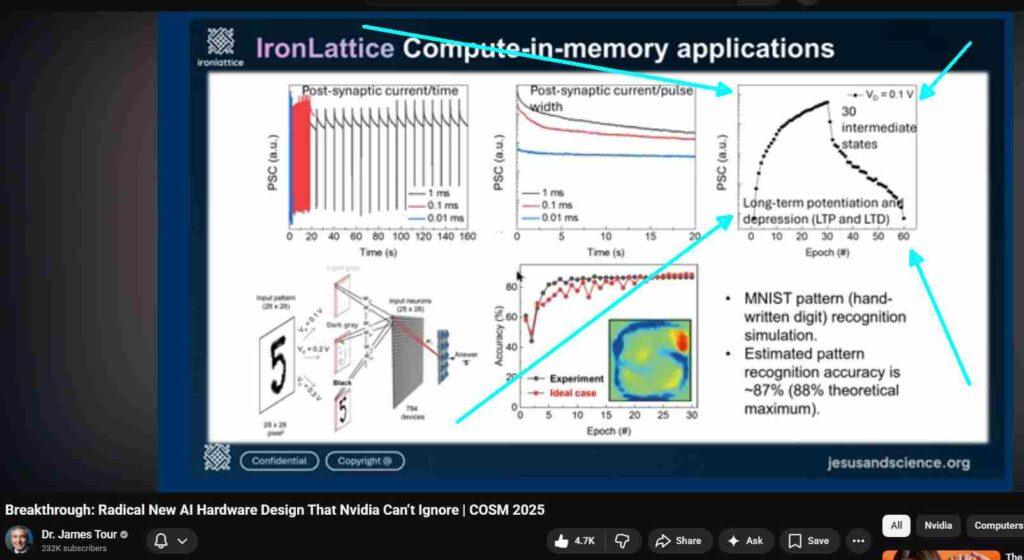
higher than that. Uh uh we've done the
6:32
compute in memory. We've put this on the
6:35
emnest system. Uh so we can read this
6:38
this hand these handwritten numbers.
6:40
We're at 87% validation here. It's got
6:43
30 discrete states. So we have all these
6:46
intermediate states. So it's not 0 1 0
6:48
1. And we have 30 discrete states that
6:50
we can access uh uh in in this this uh
6:54
post synaptic current. We can do it
6:56
current in time, current and pulse. And
6:58
uh theoretical is 88% is the theoretical
7:01
maximum. We're at 87% being able to to
7:05
read read these uh uh handwritten
7:07
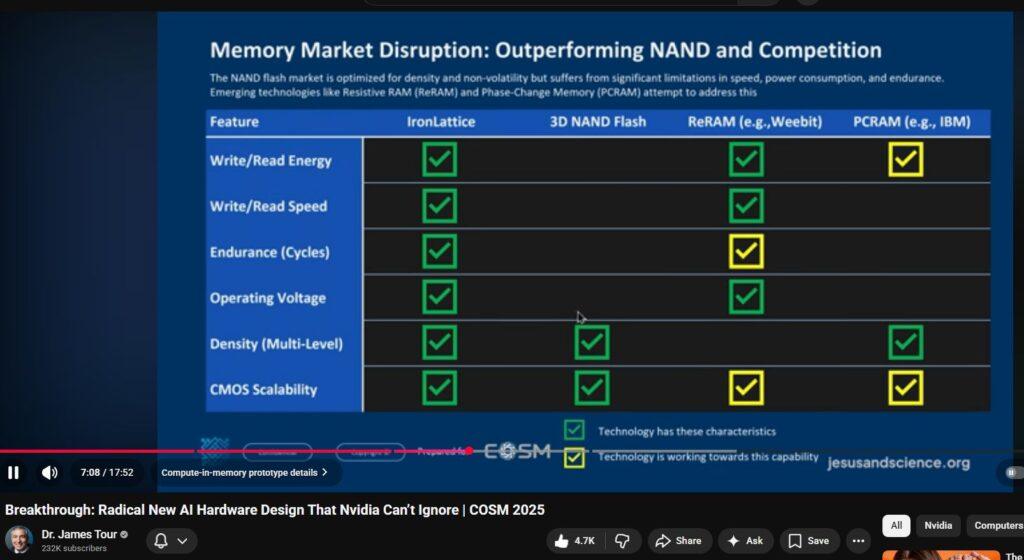
numbers. And if you look at where we are
7:09
on this, this is this iron lattice. I
7:11
think we really can address well the
7:13
read the the right read energy the right
7:16
read speed the endurance cycles the
7:18
operating voltage density and it semos
7:21
scalability and if we compare it to
7:23
other things that are out there I think
7:24
we're doing very well actually this
7:26
company wee bit this is another memory
7:28
that came out of my lab we started this
7:30
company in uh in 2015 out of my lab and
7:34
it it it's uh it's selling now on the
7:36
market it's got uh three big customers
7:38
and this is based on a on a rea system.
7:41
Uh so but uh this is this was uh this is
7:44
a memory. Uh I told them at the time
7:47
early on I said we've got to start
7:48
looking at this for uh neuromorphic uh
7:51
computation and they said no no
7:53
neuromorphic is not not really important
7:55
and it turns out to be the most
7:57
important thing right now. But anyway I
7:59
think that we we've got good standards
8:00
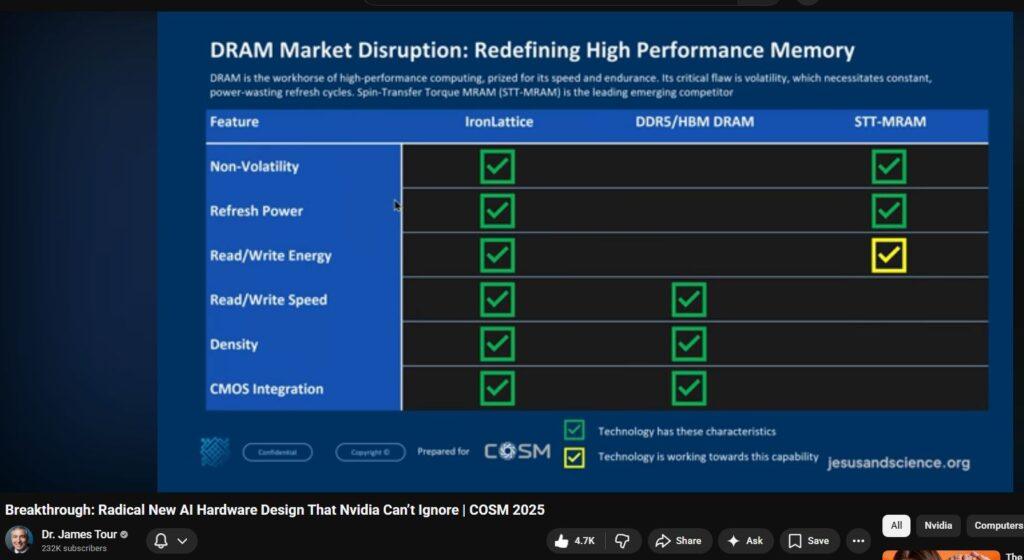
here. And then if we look at the DRAM
8:03
market disruption again we're we're
8:05
doing quite well on the DRAM uh
8:07
disruption. And I think that we can we
8:09
can handle that quite well. And then
8:11
again this this AI compute market
8:13
disruptions uh uh that if we look at
8:16
iron lattice and where we compare to
8:18
Google and Intel and mythic AI, we're
8:21
actually in discussions uh uh uh with
8:24
one of these companies right now in in
8:26
uh all under NDA discussions and with a
8:29
with a second uh large large company in
8:32
the country as well. So, uh, George just
8:34
came out with this article, uh, in the
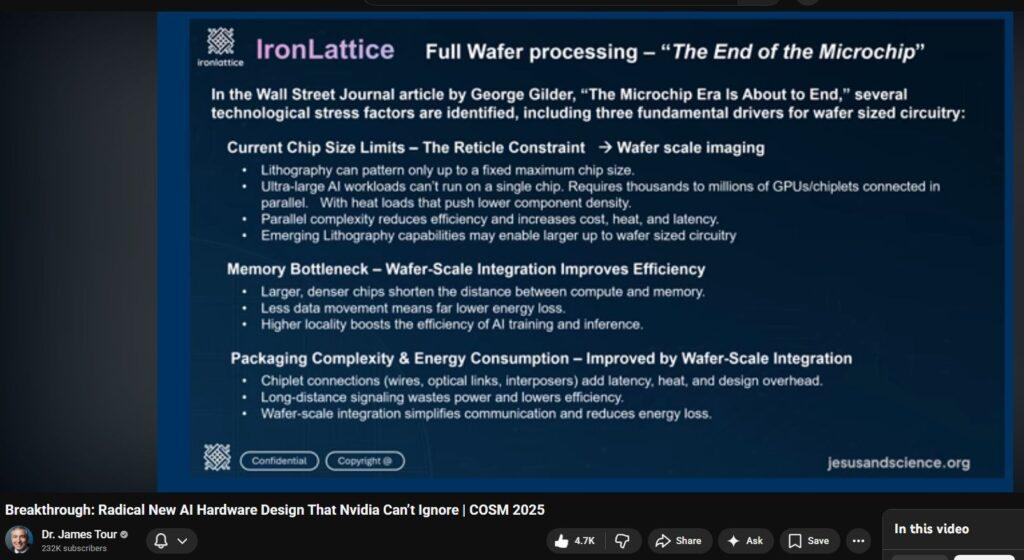
8:36
Wall Street Journal just, uh, on
8:38
November 3rd. He said, "The microchip
8:40
era is about to end. So, how could I
8:43
come here and and not at least address
8:46
this?" Because he says, you know, the
8:48
microchips are coming to an end. So, so,
8:50
uh, could we ride with this? So, we we
8:52
actually studied quite quite, uh, in
8:55
depth what what he was, uh, looking at.
8:57
So, he quote quoted to quote him in this
Market strategy & adoption path
9:00
article. He says the the microchip era
9:03
is about to end. And uh and he talks
9:06
about these three fundamental stress
9:08
factors. The current chip size limits,
9:11
the the retical constraints on the on
9:12
the building of these, the memory
9:14
bottleneck and the packaging complexity.
9:18
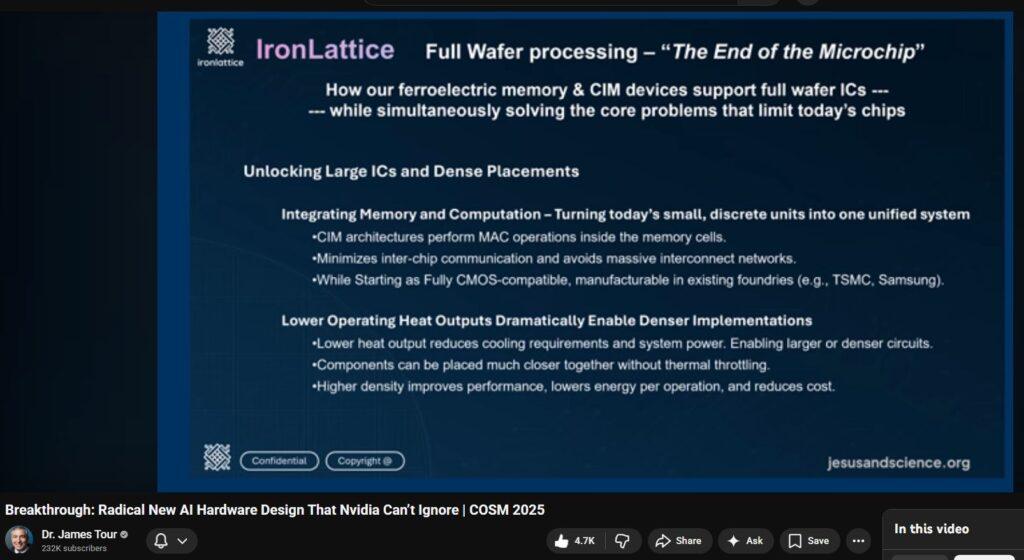
He went on and he he says he and and uh
9:21
but I think this is how our
9:22
ferroelectric memory and this compute in
9:24
memory device will support full wafer
9:27
integrated circuits while simultaneously
9:29
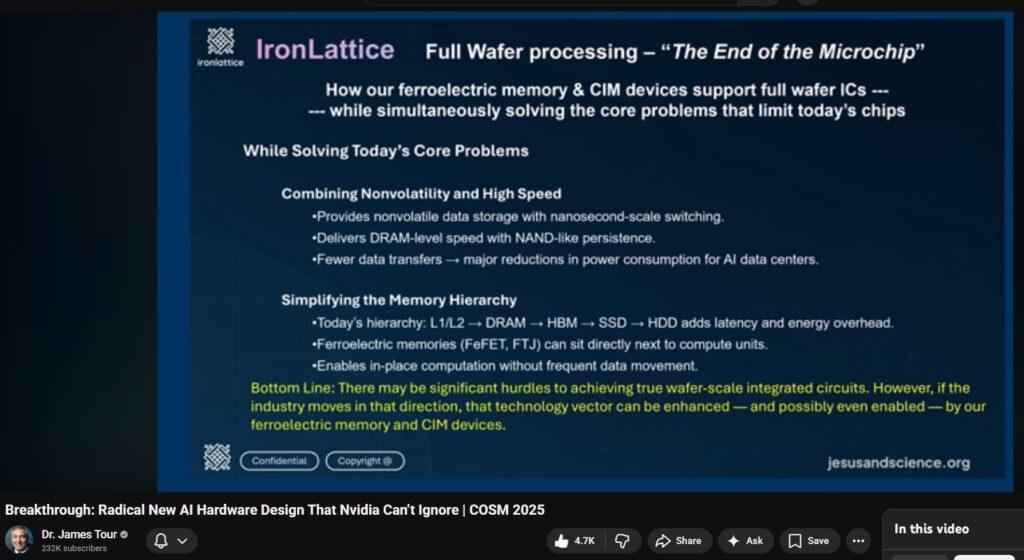
solving these core problems. So again we
9:31
think we can unlock these and our bottom
9:34
line here is after this analysis of uh
9:37
looking at what George has said is is
9:39
there may be significant hurdles to
9:40
achieve true wafer scale integrated
9:42
circuits. Uh however if the industry
9:45
does move in that direction this
9:47
technology vector can be enhanced and
9:49
possibly even enabled by our
9:51
ferroelectric memory and CIM this
9:54
compute and memory devices. Uh this is
9:57
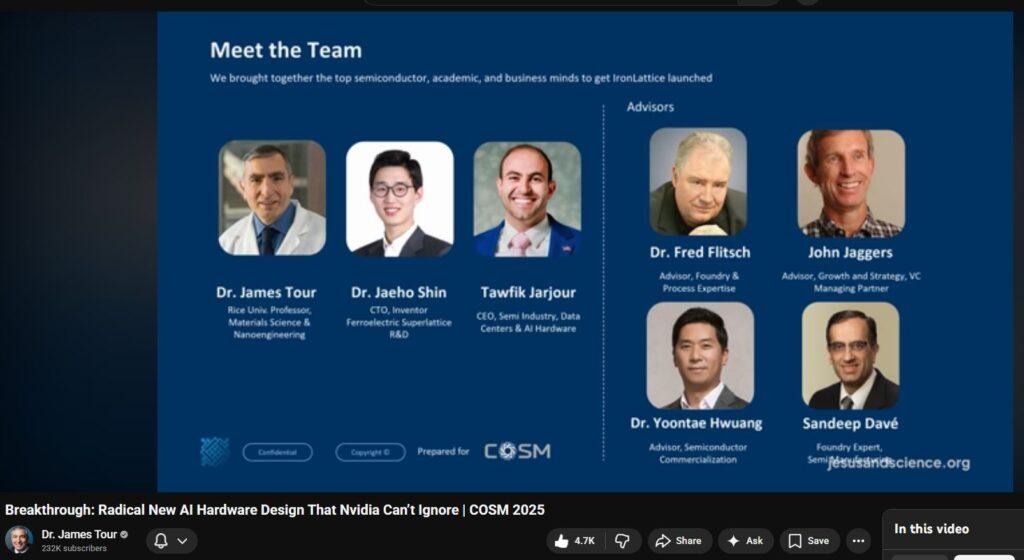
this is the group here that we've got
9:58
going. Every time we we ask somebody
10:00
who's who's deeply involved in the
10:02
industry to to uh look at this and tell
10:05
us what they think uh they want to come
10:08
on as an adviser. And so so that's what
10:10
we've got. So this has come out of my
10:12
lab. J Shin is is is the uh device
10:15
engineer in my lab that that came up
10:17
with this idea. And Tophik Jarur is is
10:19
one of my former students. He's he's
10:21
been with uh Accenture for for 13 years
10:25
working with the uh the largest uh uh
10:27
manufacturers in the world, many of
10:29
them. And so he's going to take this on
10:32
and and so here's our adviserss. Fred
10:34
has been like 35 or 40 years. he was
10:36
with IBM and he's really helped us to to
10:39
uh uh boost up our patent uh uh
10:42
portfolio. He was a a key adviser on the
10:44
patent side at IBM. So he's gone through
10:47
all our patents and then we filed more
10:48
patents to boost it up. John has been a
10:51
big investor in uh uh in in in computing
10:54
systems and then uh uh these two
10:56
gentlemen are are are deeply involved in
10:58
the semiconductor industry and foundry
11:00
experts. Uh we haven't raised a penny to
11:03
date. We've taken no money because we we
11:06
are just trying to to see what would be
11:08
the best strategy for going forward.
11:10
It's not that we're opposed to taking
11:12
money. Uh we just just uh uh haven't
11:14
haven't done anything with it because we
11:16
really want to move with the best
11:17
strategy and and uh uh this sort of
11:20
summarizes where we are on on this
11:23
advance and how we're trying to to bring
11:25
this forward. Again, it's it's this this
11:28
we there's no more busing information
11:31
back and forth to memory. It's all done
11:33
in the same device. Computation memory
11:36
in the same device and and uh this could
11:39
lower the requirements in a data center
11:42
by 80 to 90% of the energy requirements.
11:45
So you think about you think about the
11:48
amount of energy that goes into these
11:49
energy centers and we hear again and
11:51
again how it's going to suck up all of
11:53
our electricity. Well, if we if we stick
11:55
with the same devices, that may be the
11:57
case. But there could be a way to change
Q&A on scale & applicability
12:00
out devices and to change technology
12:03
behind the devices and then address the
12:05
energy problem in that way by changing
12:08
out the devices. With that, I will open
12:10
it up for questions if there are any.
12:14
[Applause]
12:18
Because of you, millions of people have
12:21
heard the gospel. If you confess with
12:23
your mouth Jesus is Lord and believe in
12:26
your heart that he's risen from the dead
12:28
and you will be saved. That's right.
12:30
That's the requirement. We talk about
12:32
science concepts which draw people in.
12:34
Take these nano machines and have them
12:36
drill into cells. It would be a great
12:38
way to kill cancer, right? We also talk
12:40
about Jesus Christ who's the best in
12:42
everything. My faith in Jesus Christ
12:45
means more to me than anything. If you
12:47
could continue to give or give for the
12:49
first time, we would certainly
12:51
appreciate it. You can go to
12:52
jesusandcience.org/donate.
12:55
All US donations are taxdeductible.
12:57
Thank you so much.
12:59
Are you subject to electromagnetic
13:01
interference on any of this? And what is
13:04
the scale going down 2 million meter
13:07
boundaries on manufacturing the tho what
13:10
is the scale uh that your process uses?
13:12
Right. So our process right now is being
13:15
done strictly in the university. So it's
13:17
not very small scale. So, this is what
13:20
we're talking about with the foundaries
13:21
that we would go we we would start
13:23
working our way down with the commercial
13:25
foundaries. As far as uh uh electro uh
13:30
as some electrical pulse or something,
13:31
we have no idea. I I just don't know. I
13:34
don't want to give a premature answer on
13:35
this. Uh uh that that's certainly an
13:39
important consideration, but I I just
13:41
don't have an answer for that. And
13:43
again, we're just at FRL 4 and remember
13:47
commercialization is nine. So we have a
13:50
a lot of steps we we still need to go.
13:53
Um Dr. this is really exciting. Uh I
13:56
just have one question to kind of
13:58
clarify this somewhat. Um, I was
14:00
wondering if if you think that your
14:02
innovations and this technology can be
14:04
applicable to all the data centers that
14:07
are being built now, including like
14:09
maybe uh Elon Musk, Colossus 1 and two
14:12
and and uh is this is this perhaps that
14:15
uh um applicable to everyone and can you
14:19
keep this um confined to the United
14:22
States or Western countries and uh keep
14:25
it from being stolen by China?
14:28
Well, it it it it is it it is applicable
14:32
to all of them. Yes. And and like I
14:35
said, we'd like to to have this stage
14:37
introduction just just start replacing
14:40
our flash memory, which flash memory,
14:42
you know, burst burst on the scene in
14:44
about uh 2001, something like that. So,
14:48
it's it's been around for about 25
14:50
years. So, it's it's about time. And and
14:53
uh uh which is really amazing
14:55
technology. you mean that you could have
14:56
electronic memory that's nonvolatile
14:59
with no moving parts and and uh uh just
15:02
by putting in a deep trench capacitor
15:04
which was really really amazing when it
15:06
came out. Um but uh uh and then then we
15:09
would begin to to switch out DRAM and
15:11
and phase this in in that way so that
15:13
it'd be an easy transition. That's the
15:15
hope. But yes, it would apply uh uh to
15:17
all the data centers. This would work
15:19
for that. As far as keeping it in the
15:22
United States, I mean that's what we
15:24
want to do. We we certainly want to keep
15:26
this in the United States, but you know,
15:29
we are in a university and I have a
15:31
group of all sorts of people. I mean,
15:32
the FBI has come to me and said, you
15:35
know, we we're concerned you you know,
15:37
do you have any any students that might
15:40
be spies? And I'm like, I I don't know.
15:44
You're the guy said, you're supposed to
15:46
tell me it. So, they came back again. I
15:48
said, fear not. You don't have to worry.
15:50
I asked all my guys. I said, are you
15:52
spies?
15:53
They all said no. So, we're good to go.
15:56
I mean, I I don't I don't know what more
15:58
I could do. If they're a spy, you you
16:00
stop them at the border. I mean, that's
16:02
up that's your job, not my job. So, um
16:05
uh you know, we do the best we can, but
16:07
I I don't I don't do any classified work
16:10
in my laboratory. Uh because if you
16:13
really do classified work, you can't do
16:15
it in a university. You have to have a
16:17
special facility. Uh the nearest
16:19
facility to me is NASA. And and uh if
16:22
you do classified work, every time I I I
16:24
I even need to use the restroom, you
16:26
have to take out the hard drive, put it
16:28
in a in a locked cabinet, go to the
16:30
restroom, come back and put the thing
16:32
back in. And this just doesn't work at
16:34
my age. I mean, it's just
16:37
it's not the way to go. And so, so uh we
16:40
don't do classified work. And and and
16:43
the way we succeed is we share
16:45
information between all of us. We sit in
16:47
group meetings for hours and they want
16:49
everybody to contribute to this. So um I
16:53
I just remember how we beat the Soviet
16:55
Union. We beat the Soviet Union not by
16:58
keeping things absolutely hardened and
17:01
concealed. We beat the Soviet Union by
17:03
by sharing information between us. They
17:06
kept things secret and we beat the pants
17:07
off of them and it was all based around
17:10
silicon technology and that's because we
17:12
had an open system of sharing and
17:14
communicating and that that's the way we
17:16
succeed.
17:20
Thank you for joining me today. If you
17:21
could give us a like, share, or podcast
17:24
review, we would appreciate it. If you
17:26
have any questions, you could send them
17:28
to ask at jesusandscience.org
17:31
and we'll try to answer some of those
17:32
questions in an upcoming video. And if
17:35
you do not believe in the physical
17:36
resurrection of Jesus Christ and you
17:38
want to hear about why I believe, send
17:41
me an email to tour drsour.org
17:45
or and we'll get together by Zoom and
17:48
I'll share with you why I embrace the
17:50
resurrection of Jesus
Visited 5 times, 1 visit(s) today