Eclipsing from hodge-podge 2-base-10 and “sneaker net”, we built a complex multi-office routed network based primarily upon Linux but also hosting Lotus Notes servers and Windows NT4 servers in the full-blown Microsoft configuration with numerous Windows 95 workstations at several locations. (OS/2 was later tested, and Novell Netware held some legacy ground for years, but ultimately of course Linux won out over all and now by unequaled margin.)
Onto that bleeding-edge octopus was supposed to drop seamlessly Borland Paradox running avant-garde custom-written title closing software. BP failed miserably in preliminary testing, however, and was promptly abandoned. Properly designed, the network resiliently supported all subsequent softwares, first LandTech DOS, then a successor, then ultimately some cloud-based thing.
Curious, we looked to see what happened to Borland Paradox.
Borland Paradox didn’t just “die” — it went through a long, messy chain of corporate sell-offs, rewrites, product cannibalization, and strategic abandonment. Here’s the definitive, expert-level breakdown of what actually happened to it.
What Happened to Borland Paradox (Full History & Why It Disappeared)
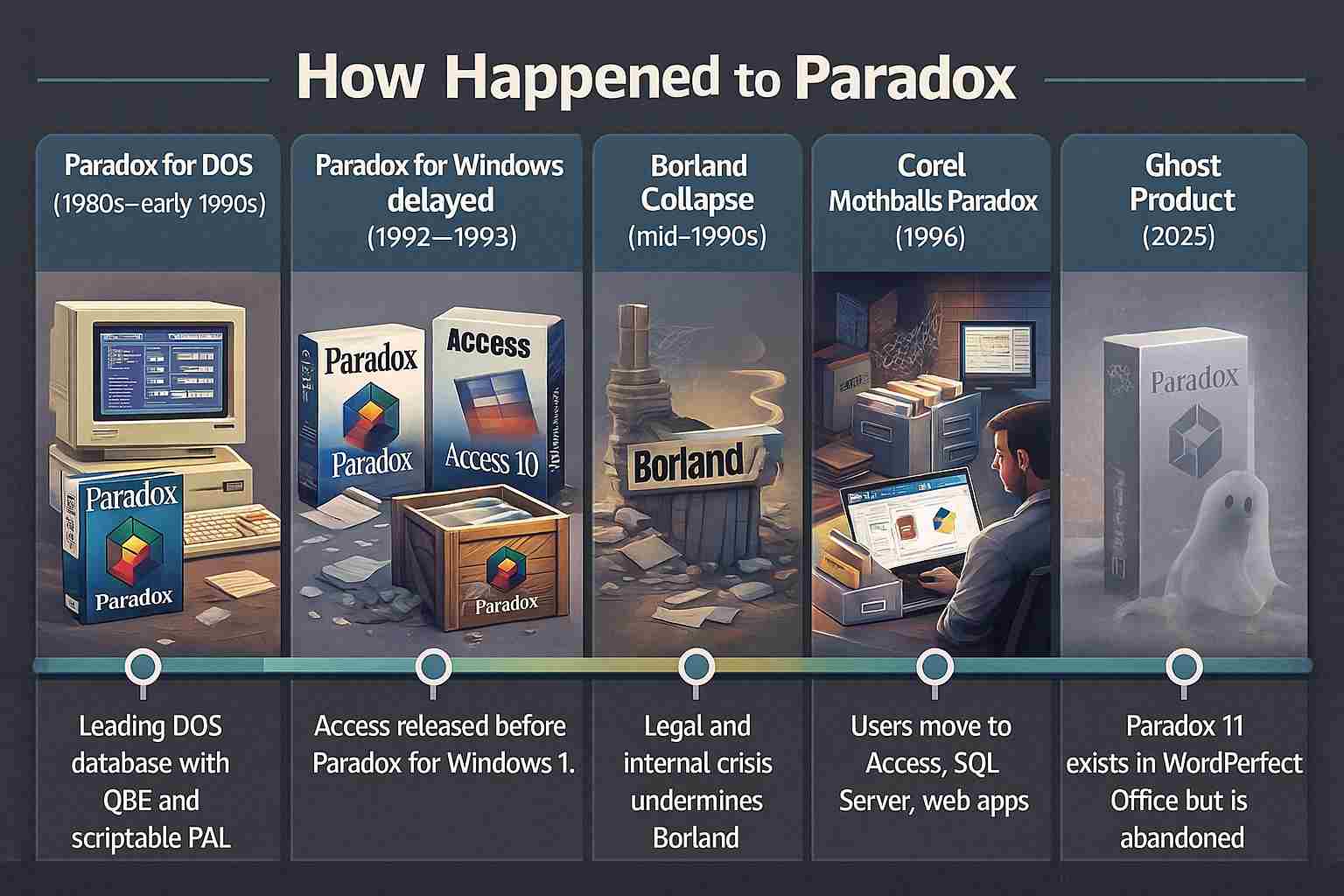
1. Paradox was one of the best DOS databases ever made (1980s–early 1990s)
Paradox for DOS (originally by Ansa Software, acquired by Borland in 1987) was extremely fast, famously elegant, and scriptable with PAL (Paradox Application Language).
It became the database of choice for thousands of businesses because:
- It had an incomparable QBE (Query-By-Example) interface
- It was fast on indexed files
- It let power users build full applications without heavy coding
- It bundled a runtime for custom deployable apps
By 1990–1992, Paradox was actually MORE profitable for Borland than Turbo Pascal.
2. Paradox for Windows was late — and that was fatal
Microsoft launched Access 1.0 in 1992.
Paradox for Windows did not ship until 1993, after multiple delays and architectural rewrites.
This delay was catastrophic:
- Microsoft bundled Access cheaply (or free with some Office bundles)
- Access tied directly into the emerging Office ecosystem
- Paradox required developers to rewrite from PAL → ObjectPAL, breaking backward compatibility
Businesses chose Office integration over a standalone powerhouse database.
3. Borland itself collapsed under legal and competitive pressure (mid-1990s)
Two major problems hit simultaneously:
a. Borland vs. Microsoft: The Hiring Lawsuit
Borland hired Mike Maples and Gordon Eubanks, triggering a major lawsuit from Microsoft.
The battle drained the company financially and derailed R&D momentum.
b. Internal crisis following Philippe Kahn’s exit
Kahn (Borland’s founder) was removed under board pressure, and restructuring crippled ongoing development.
Paradox became a victim of the broader corporate meltdown.
4. Corel acquired Paradox — and effectively mothballed it (1996)
In 1996, Borland sold Paradox, Quattro Pro, and the rest of Borland Office to Corel.
Corel’s strategy:
- Push WordPerfect Office
- Use Paradox as a “checklist item” to claim a full Office suite
- Invest the bare minimum in development
Paradox received almost no new engineering after the late 1990s.
It technically still exists as part of WordPerfect Office Professional, but:
- It has not had a major modern rewrite
- It is effectively in maintenance mode
- The user base dwindled to legacy corporate environments
5. The user-community (and corporate installs) slowly migrated away
Paradox lost ground because:
- Office + Access dominated the corporate desktop
- SQL Server, Oracle, MySQL became the real enterprise models
- Visual Basic, Delphi, and web apps replaced desktop DB frontends
- Paradox never transitioned cleanly to 64-bit Windows
- Development stagnation pushed consultants toward Access, FileMaker, or custom apps
Many Paradox systems survived into the 2010s because DOS-based Paradox was rock-solid.
But by 2018–2024, the remaining businesses mostly migrated to:
- Access
- SQL client-server apps
- Web-based CRUD apps
- Python/Node.js front ends
Paradox became unmaintainable on modern Windows.
6. Today (2025): Paradox still technically exists — but only as a ghost product
Paradox 11 is still sold inside WordPerfect Office Professional. However:
- No major new engine development has occurred in ~20 years
- Large parts of the codebase are frozen
- It remains 32-bit
- It’s used only by die-hard legacy shops or locked-in vertical apps
In practical terms, Paradox is effectively:
Dead as an evolving product, alive only as a legacy compatibility artifact.
7. Why Paradox REALLY died (summary of root causes)
✔ The Windows rewrite delay (Access beat it to market)
✔ Borland’s corporate legal battles and collapse of leadership
✔ The shift from desktop databases → client/server → web
✔ Corel’s disinterest in real development
✔ Breaking backwards compatibility (PAL → ObjectPAL)
✔ Lack of Office ecosystem integration
✔ No 64-bit modernization
8. Key takeaway
Paradox didn’t fail because it was inferior. Objectively, Paradox for DOS was better engineered than Access. It died because Microsoft bundled Access. Borland imploded. Corel neglected it. …and the world moved on to web-based database systems.