A great use of AI and open-source.
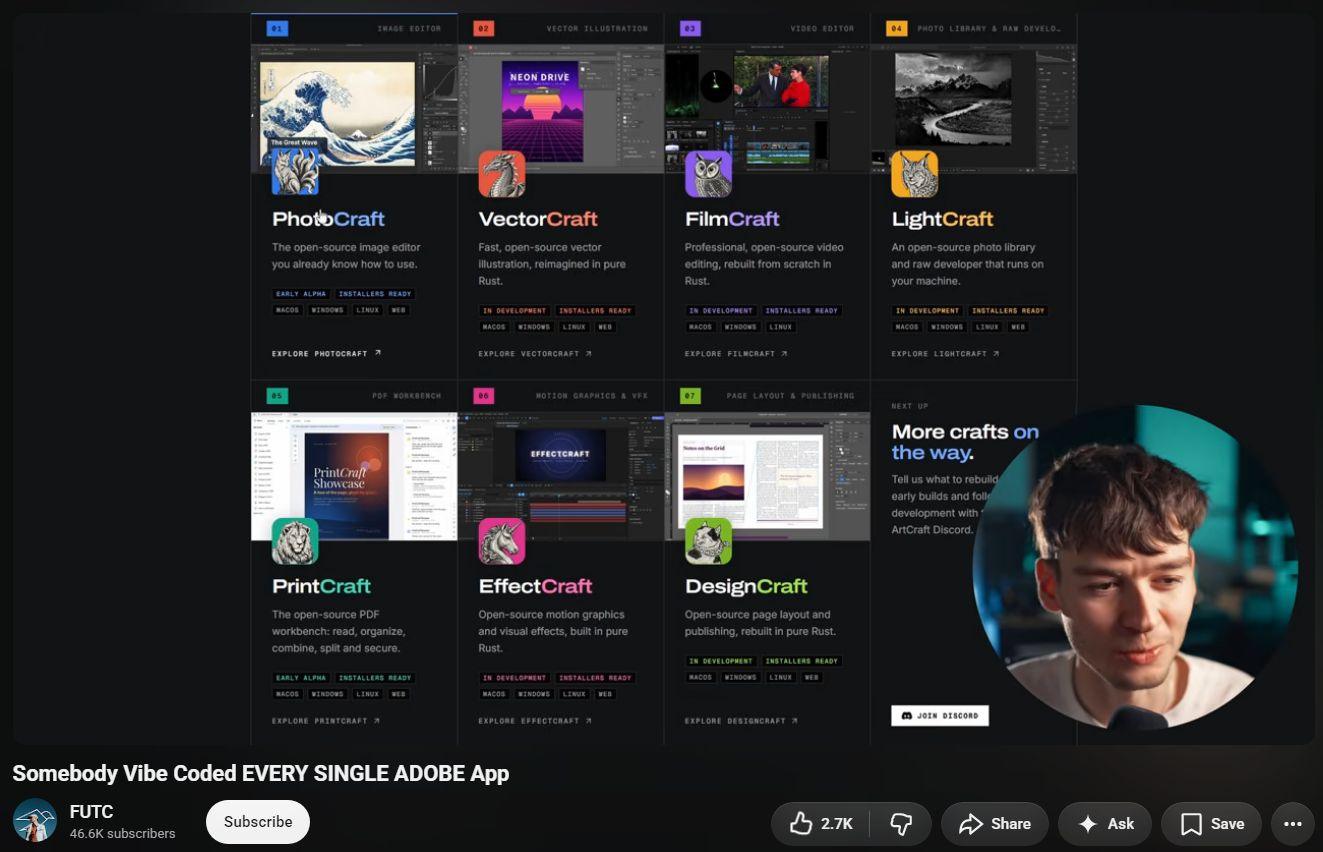
Deeply, thoroughly open-sourced in fast, solid RUST language, https://github.com/storytold/photocraft is clean-room reimplementation — recreation of the workflows, muscle memory, panels, formats, and habits without copying Adobe’s proprietary code/assets. In other words: not “piracy,” but far more humiliating: A public dashing of its empire as mechanically reproducible.
Adobe is the rare corporation that managed to turn “creative tools” into a rent-seeking tollbooth on human expression.
Born in the PostScript era, Adobe did not merely sell software; it positioned itself between the maker and the page. It helped turn printing, fonts, and layout into licensed chokepoints — a world where every curve, glyph, page, proof, and output pipeline could become another invoice. Its early power came from the desktop-publishing boom: PostScript, Illustrator, Photoshop, and the font wars made Adobe indispensable to printers and designers, while its type business helped normalize the idea that even the alphabet could be metered, licensed, restricted, and monetized.
Then came the great gobbling. In 1994 Adobe bought Aldus, maker of PageMaker, absorbing one of the foundational desktop-publishing products rather than simply outcompeting it. PageMaker had helped create the market; Adobe digested it. QuarkXPress then became the layout king Adobe spent years trying to kill, eventually doing so not by romance or brilliance alone but by bundling, ecosystem lock-in, file-format gravity, and the slow suffocation of alternatives through Creative Suite and later Creative Cloud.
Its history with Microsoft was less a heroic duel than a cartel-adjacent dance of platform power, font standards, document formats, and monopoly-era leverage. Adobe fought Microsoft when useful, partnered when profitable, and always sought the same end: control the standard, own the workflow, tax the user.
The PDF became its masterpiece of enclosure disguised as universality: a “portable document” format that conveniently made Adobe the priesthood of portability. Flash became another empire: ubiquitous, insecure, bloated, battery-murdering, and eventually despised into extinction. Adobe’s pattern repeated: colonize the creative pipeline, make itself unavoidable, then charge rent forever.
And Creative Cloud was the mask-off moment. No more buying tools. No more owning the means of creation. Designers, photographers, illustrators, editors, students, freelancers — all marched into the subscription paddock, paying tribute monthly for the privilege of opening their own work. Miss a payment and the tools vanish. Your archive becomes a hostage. Your craft becomes a utility bill.
Adobe is not “creative.” Adobe is the landlord of creativity: a beige vampire in a black turtleneck, extracting rent from pixels, letters, pages, brushes, and memories. It did not merely serve artists; it fenced them in, bought the exits, poisoned the wells, and called the cage an ecosystem.
If Adobe is finally being undone, it is not because it lacked power. It is because every monopoly eventually mistakes captivity for loyalty. Designers remember. Printers remember. Web users remember Flash. Freelancers remember the subscription shakedown. The alphabet remembers.
Adobe’s original sin was not Photoshop. It was PostScript: the elegant little page-description language that let Adobe wedge itself between the computer and the printed page.
In the mid-1980s, Adobe’s genius was to make PostScript the brains of high-end desktop publishing output. Apple licensed it for the LaserWriter in 1985, Aldus PageMaker rode that wave, and suddenly “desktop publishing” existed as an industry. Then other printer makers, including HP, licensed PostScript or PostScript-compatible technologies for laser printers and imagesetters. Adobe had found the perfect parasite position: not just selling an app, but taxing the act of turning thought into print.
This was the template for everything that followed:
- Own the standard.
- License the interpreter.
- Control the font pipeline.
- Make the workflow depend on you.
- Collect rent from every serious output device.
PostScript was brilliant technology, but commercially it made Adobe the toll collector of the page. Printers, service bureaus, designers, publishers — all had to orbit the Adobe sun because the final artifact, the printed page, passed through Adobe’s language and Adobe’s fonts.
Then came the font racket. Adobe Type 1 fonts became central to professional publishing, and Adobe’s power expanded from describing pages to monetizing the very shapes of letters. Not the words, not the writing, not the author’s thought — the outlines of the glyphs themselves. Every “A,” every comma, every elegant ligature could become
another licensed asset in the priesthood of output.
Microsoft and Apple eventually pushed back with TrueType, partly to escape Adobe’s font chokehold. Adobe responded with more standards maneuvering, more licensing gravity, and eventually OpenType with Microsoft — because Adobe’s real instinct was never rebellion against monopoly. It was to become the monopoly’s typographic department.
Then Adobe bought Aldus in 1994, swallowing PageMaker, the very desktop-publishing product that had helped make PostScript indispensable. Later, when QuarkXPress dominated professional layout, Adobe came back with InDesign and Creative Suite bundling: the slow garrote instead of the duel. Quark was beaten not merely by one better app, but by Adobe’s growing control of the surrounding ecosystem — fonts, PDFs, Photoshop, Illustrator, Acrobat, bundled pricing, file expectations, training, and institutional inertia.
The arc is simple and ugly:
PostScript put Adobe inside the printer.
Type 1 put Adobe inside the alphabet.
PDF put Adobe inside the document.
Creative Suite put Adobe inside the studio.
Creative Cloud put Adobe inside the billing cycle.
That is the Adobe pattern: arrive as infrastructure, become dependency, convert dependency into rent. The company did not merely sell creative tools. It colonized the path from mind to mark — from screen to printer, from letterform to license, from document to archive — then charged the makers for passage.
Adobe’s empire began when it learned that the richest place to stand was not beside the artist, but between the artist and the output.
If by “PhotoMac” you mean the pre-Adobe / original Macintosh image editor lineage that became Photoshop, the key point is:
Photoshop was not born inside Adobe. Adobe bought/licensed into somebody else’s breakthrough.
The real origin story:
- Thomas Knoll, a University of Michigan PhD student, wrote a Mac program in 1987 called Display to show grayscale images on a black-and-white Macintosh screen.
- His brother John Knoll, working at Industrial Light & Magic, saw it and pushed Thomas to turn it into a serious image-editing tool.
- The program evolved through names like ImagePro and then Photoshop.
- Before Adobe, it was commercially distributed in a small way as Barneyscan XP, bundled with Barneyscan’s high-end color scanners. Roughly a couple hundred copies shipped
this way. - Adobe then licensed/distributed it, releasing Adobe Photoshop 1.0 in 1990 for Macintosh.
So the hater framing is:
Adobe did not descend from heaven with Photoshop carved on stone tablets. It found a brilliant independent Mac image tool, put its corporate mouth around it, and spent the next three decades pretending the rent temple was the same thing as the invention.
The pattern matches the rest of Adobe’s empire:
- PostScript: insert yourself between computer and printer.
- Fonts: insert yourself between language and page.
- Photoshop: acquire/control the tool between image and output.
- PDF: insert yourself between document and reader.
- Creative Cloud: insert yourself between creator and their own archive.
Photoshop’s true early magic was Knoll-family craft: hacker ingenuity, Mac-native visual computing, scanner-era digital imaging, and ILM-grade practical image manipulation.
Adobe’s genius was not creation so much as capture — spotting the choke point, branding it, standardizing it, then slowly turning the tool into a subscription altar.
Sharper line:
Photoshop began as a weird, brilliant Mac image hack. Adobe turned it into a global pixel tollbooth.