Here’s a breakdown of what NetSuite is doing with AI — and what features they’re offering (or building) to bring AI into enterprise resource planning (ERP), analytics, finance, and business workflows.
Why AI matters for NetSuite
- NetSuite is a unified cloud-based ERP / business-management platform that already covers accounting, inventory, CRM, order management, etc. (Wikipedia)
- Because all of a company’s data lives in one place in NetSuite, it creates a strong “single source of truth” — ideal for AI/ML and analytics to build on. (NetSuite)
- With businesses generating more data (transactions, sales, orders, inventory, etc.), AI helps by automating repetitive tasks, spotting patterns & anomalies, generating insights, and enabling more data-driven decisions. (NetSuite)
What NetSuite’s AI features actually do (as of 2024–2025)
Here are many of the main AI-powered capabilities in NetSuite now or soon — across analytics, finance, automation, customization, and user experience:
Natural-language assistant / conversational AI & “agentic workflows”
- With NetSuite Next, NetSuite embeds conversational AI that lets users ask questions in plain language (rather than navigating complex menus) and get context-aware answers. (NetSuite)
- This includes generating visualizations, explanations, and reasoning — not just raw data — so users can understand why something is happening. (NetSuite)
- “Agentic workflows” let AI agents run tasks (even proactively) based on user instructions, with users able to monitor progress, review results, and intervene — effectively automating more complex workflows without losing human control. (NetSuite)
Analytics, data insights, forecasting & anomaly detection
- Through NetSuite Analytics Warehouse (NSAW), NetSuite uses AI/ML for self-service analytics, data preparation, reporting, visualization, and predictive analysis — helping business to uncover hidden patterns and make forecasts. (Oracle Docs)
- A recent addition, “Contextual Insights”, auto-generates comparative insights (text + visuals) so teams can quickly see how a subset of data compares to the whole set. (NetSuite)
- For finance and operational forecasting, AI-powered modules (such as those under planning, budgeting and close management) use machine learning to suggest forecasting methods, evaluate variances, detect anomalies in journal entries, invoices, orders, and flag items for review. (NetSuite)
Automation of repetitive tasks, document processing, and content generation
- NetSuite Text Enhance — an AI-driven writing assistant that can generate, refine or translate content automatically (e.g. emails, product descriptions, reports), saving time and reducing manual effort. (ERP Peers)
- NetSuite Bill Capture — uses AI (including optical character recognition, or OCR) to scan, parse and populate bill/invoice data automatically, matching it against purchase orders or other documents. Helps reduce manual data entry and errors. (NetSuite)
- In modules like finance close or compliance/audit, AI auto-generates summaries, flags exceptions or anomalies (e.g. unusual invoices or sales orders), and suggests potential corrections or next steps — streamlining audits, financial close, and compliance reviews. (NetSuite)
Developer / customization tools powered by AI
- Developers working on customizations or integrations (e.g. using SuiteCloud) get access to AI-driven toolkits: e.g. a generative-AI SuiteScript API + AI-powered code-assist tools (for writing, documenting, testing custom code faster). (NetSuite)
- Admins and power-users can use Prompt Studio to define and tune AI prompts and control how AI-generated output should look (tone, style, structure) — giving more control and adaptability for different business needs. (NetSuite)
- Integration features like NetSuite AI Connector Service enable connecting external AI models or assistants to NetSuite in a governed, secure way — meaning if a business wants to plug in specialized AI/LLMs, they can. (Oracle)
Sales & customer-facing workflows (e.g. quotes/configuration)
- For businesses selling configurable or complex products, NetSuite added a NetSuite CPQ AI Assistant, supporting AI-powered “configure, price, quote” workflows — helping sales teams or even customers get quotes (e.g. for custom products) faster with conversational-style interactions. (Oracle Docs)
- This reduces manual configuration effort and speeds up sales cycles. (SiliconANGLE)
Multilingual support & global readiness
- Text Enhance now supports multi-language translation, helping businesses operating across different geographies to generate or translate content in various languages. (NetSuite)
What’s new & what’s coming (near future / recent 2025 enhancements)
- In October 2025, NetSuite expanded SuiteCloud’s AI capabilities — enabling customers/partners to integrate external AI models, build custom AI agents (called “SuiteAgents”), embed AI services, and create AI-driven workflows tailored to their business. (Oracle)
- New developer-oriented AI toolkits (document analysis, reasoning, narrative reporting, etc.) are being rolled out so SuiteApps can more deeply embed AI. (Oracle)
- More advanced forecasting, anomaly detection, AI-assisted closure management, and interactive analytics capabilities are being added (e.g. multivariate predictions, job-analytics insights to help with financial close processes). (NetSuite)
- AI assistants integrated into help/support (knowledge centers) — e.g. when users have questions about using NetSuite, an AI-powered expert can provide concise answers without needing to manually dig through documentation. (NetSuite)
What this means for businesses using NetSuite
- Time saved & efficiency boosted — Routine tasks (data entry, invoice processing, report writing, quotes) can be automated or semi-automated, freeing up human resources for higher-value tasks
- Better, faster insights & decision-making — With AI-driven analytics + forecasting + anomaly detection + natural-language queries, businesses can respond more quickly to trends, spot issues earlier, and make data-driven decisions without needing a heavy BI team
- More flexibility & customization — Through SuiteCloud, businesses can build custom AI agents, tailor workflows, integrate external AI models, and adapt NetSuite to their unique operations and industry
- Improved collaboration & accessibility — Because AI features are built-in and conversational, more people (not just data experts) in an organization can access actionable insights and analytics — leveling up across departments
Here are 10 real-world style use-case examples that show exactly how businesses are using NetSuite’s AI today across finance, operations, analytics, sales, and HR. These are based on functions NetSuite has publicly released or demonstrated (Bill Capture, Text Enhance, CPQ AI Assistant, Analytics Warehouse, Predictive Insights, Anomaly Detection, SuiteCloud AI Toolkit, SuiteAgents, etc.).
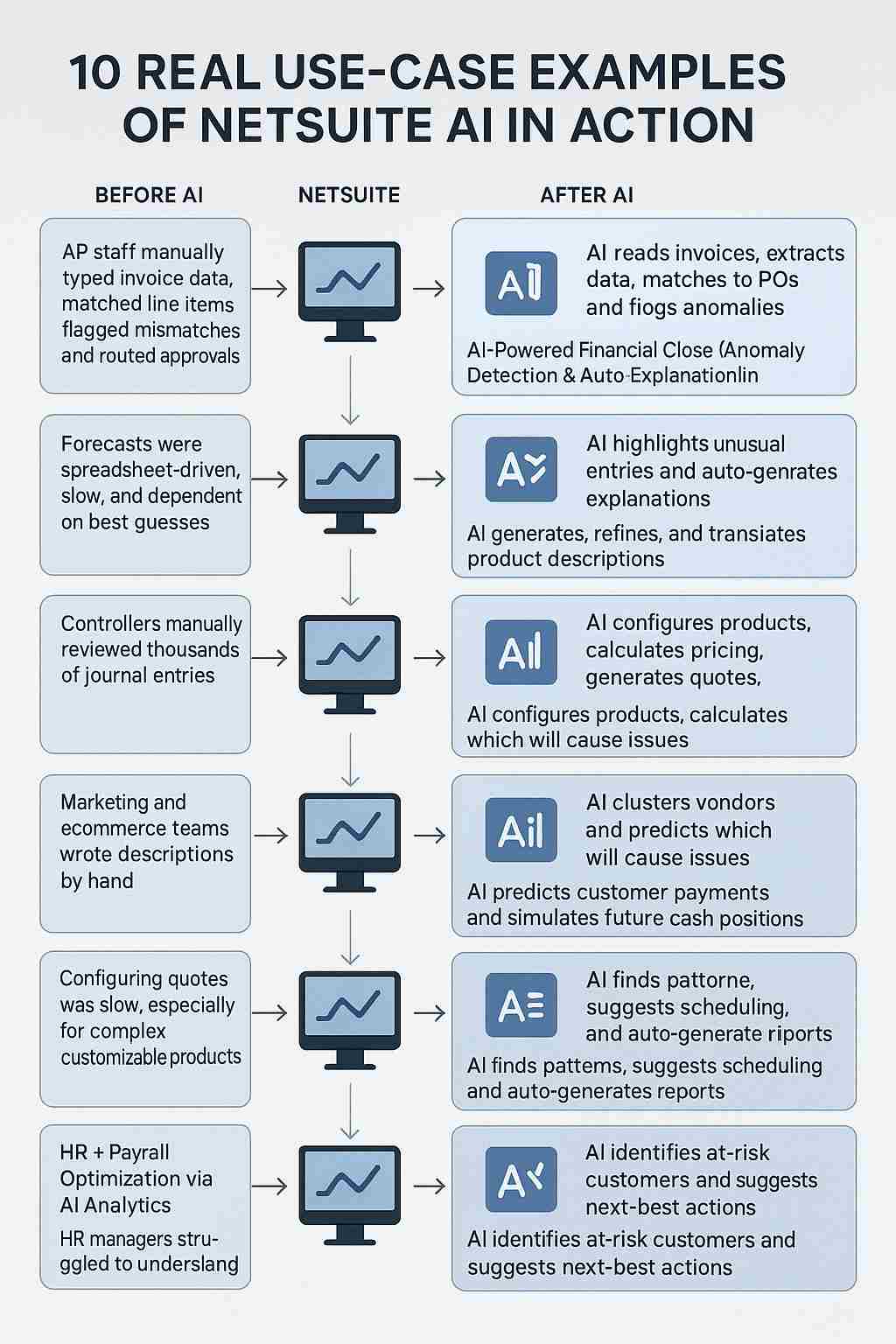
10 REAL USE-CASE EXAMPLES OF NETSUITE AI IN ACTION
1. AI-Driven Invoice/Bill Automation (Accounts Payable)
Before AI: AP staff manually typed invoice data, matched line items, flagged mismatches, and routed approvals.
After AI (NetSuite Bill Capture):
- AI reads invoices automatically (OCR + ML).
- Extracts vendor, amounts, items, terms.
- Auto-matches to POs and receipts.
- Flags anomalies (duplicate charges, unusual amounts).
Result:
Companies cut 70–90% of manual AP entry time and reduce errors significantly.
2. AI Forecasting for Sales & Inventory Planning
Before: Forecasts were spreadsheet-driven, slow, and dependent on best guesses.
After (NetSuite Planning/Analytics Warehouse AI):
- AI evaluates historical sales seasonality.
- Predicts future demand by SKU, region, and customer segment.
- Recommends optimal inventory levels.
Result:
A mid-size distributor reduced stockouts by 22% and over-production by 18%.
3. AI-Powered Financial Close (Anomaly Detection & Auto-Explanation)
Before: Controllers manually reviewed thousands of journal entries.
After:
- AI highlights unusual entries (timing, amount, vendor, GL pattern).
- Suggests likely causes (“This variance appears due to late shipping receipts”).
- Auto-generates narrative explanations for auditors.
Result:
Financial close time dropped from 12 days → 7 days.
4. AI Writing Assistant for Product Descriptions (Text Enhance)
Before: Marketing and ecommerce teams wrote hundreds of product descriptions by hand.
After:
- AI writes descriptions in selected tone (technical, casual, persuasive).
- Auto-translates for multi-country catalogs.
- Writes SEO-optimized copy based on product specs.
Result:
E-commerce companies created full catalogs 5× faster with consistent brand voice.
5. AI-Driven Quote Generation for Sales Teams (CPQ + AI Assistant)
Before: Configuring quotes was slow, especially for complex customizable products.
After:
- Sales reps type: “Create a quote for 12 custom units with option B and extended warranty.”
- AI configures product, calculates pricing, applies discounts, generates quote layout.
- Flags incompatible product combinations.
Result:
Sales teams issue quotes in minutes instead of hours and reduce errors dramatically.
6. Supplier Risk & Spend Analysis (AI Insights)
Before: Procurement teams manually analyzed vendor performance.
After:
- AI clusters vendors based on risks (late shipments, cost spikes, quality issues).
- Predicts which suppliers are likely to cause issues next quarter.
- Recommends alternative vendors.
Result:
One manufacturing user reduced supplier-related delays by 30%.
7. AI-Powered Cash Flow Forecasting
Before: Controllers manually forecasted receivables vs payables and seasonal inflows.
After:
- AI predicts when customers will actually pay.
- Identifies customers likely to pay late.
- Simulates future cash positions based on trends, orders, expenses, and historic cycles.
Result:
Companies improved cash projection accuracy by 25–40%.
8. HR + Payroll Optimization via AI Analytics
Before: HR managers struggled to understand turnover, overtime patterns, and staff cost leakage.
After:
- AI finds patterns in overtime abuse, staffing mismatches, and turnover predictors.
- Suggests optimal scheduling mixes.
- Auto-generates HR reports (headcount, attrition explanations, cost breakdowns).
Result:
One services company reduced overtime costs by 17% in 6 months.
9. AI-Powered Customer Behavior Insights (Sales/CRM)
Before: CRM data was underused — lots of activity logs, no real insights.
After:
- AI identifies customers that are “at-risk” based on purchase decline patterns.
- Suggests next-best actions (“Upsell SKU A”, “Send renewal notice”).
- Generates outreach emails tailored to the customer profile.
Result:
SaaS and subscription businesses increased retention by 8–12%.
10. AI Assistant for Admins & Developers (SuiteCloud + SuiteAgents)
Before: Customization required manual scripting and deep platform knowledge.
After:
- AI generates SuiteScript code (“Build workflow that assigns leads > $50k to Senior AE”).
- Suggests tests, validations, and optimizes code.
- Can run agentic workflows that execute tasks autonomously, with human approval points.
Result:
Dev teams build custom automations 2–3× faster with fewer errors.