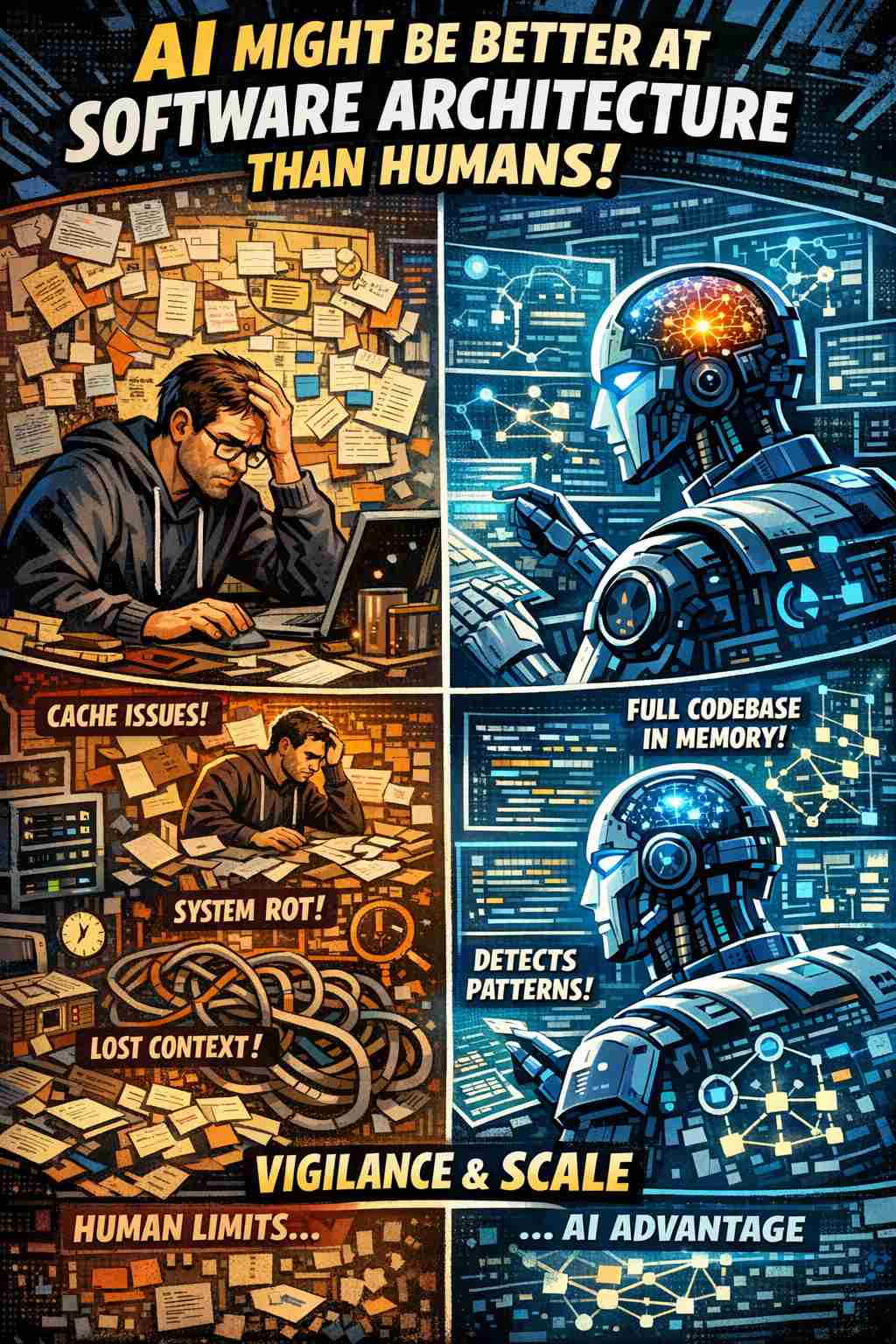
“AI can hold a 200k token context window (150k words) in a form of attention that allows constant cross-referencing across that entire input length… This isn’t intelligence in the human sense, it’s something different: Comprehensive pattern matching across a very large context window, with the ability to apply consistent rules without fatigue or forgetfulness — now look at what that means for the entropy (“rot”) problem…” 11:58 https://www.youtube.com/watch?v=NoRePxSrhpw
“Our goal is simply to put AI in the parts of the [pipeline] where humans were going to lose to entropy anyway.” 21:19 https://www.youtube.com/watch?v=NoRePxSrhpw
Transcript
Click to reveal
0:00
AI might be better at software
0:01
architecture than humans. Not because AI
0:04
is smarter, but because humans are
0:06
structurally incapable of the kind of
0:08
vigilance that good scaled technical
0:11
architecture requires. That's a very
0:13
strong claim and it cuts against
0:14
everything we've been told typically. So
0:16
the conventional wisdom for a couple of
0:18
years now has been AI is bad at
0:21
technical architecture because
0:22
architecture requires holistic thinking,
0:24
creative judgment, wisdom accumulated
0:27
over the years. And architecture is
0:29
supposedly one of the last bastions of
0:32
human engineering, the domain where
0:34
experience and intuition matter the
0:36
most. But here's what I keep noticing.
0:38
When engineers describe their
0:41
architectural failures, the performance
0:43
that degraded over months or caching
0:45
layers that broke quietly or technical
0:47
deck that kept accumulating despite
0:49
everybody's best intentions, the root
0:51
cause is almost never bad architectural
0:54
judgment. It's almost always lost
0:57
context. The information needed to
0:59
prevent the problem did exist. It was
1:02
just spread across too many files, too
1:04
many people, too many moments in time.
1:06
No single human mind could hold it all
1:09
at once. The original architectures are
1:11
often fine. The engineers are competent.
1:13
The code reviews are typically thorough.
1:15
But somewhere between the initial design
1:16
and the daily reality of shipping
1:18
features to production, systems rot. And
1:21
every individual change can make sense
1:22
and everything can pass review. And yet
1:24
together we get into a position where we
1:26
create messes that no single person saw
1:29
coming. It's sort of a tragedy of the
1:31
commons written in architectural
1:33
failure. It's not a dramatic collapse.
1:35
feels more like a slow rot and it
1:37
doesn't mean that people are bad
1:39
engineers. Good engineers operating
1:41
under human cognitive constraints can
1:43
still get into this situation. So I
1:45
wanted to ask a provocative question.
1:47
What if we've been thinking about all of
1:49
this backwards? What if there are
1:51
specific dimensions of architectural
1:54
work where AI isn't just adequate but
1:56
structurally superior to humans? Not
1:58
because of intelligence, but because of
2:02
attention span, memory, and the ability
2:04
to hold an entire codebase sort of in
2:07
mind while evaluating a single line
2:09
change. And increasingly, as you get
2:10
larger and larger context windows and
2:12
searchable context, that becomes a more
2:14
viable mental model to imagine for our
2:16
AI agents. This is not a palemic about
2:20
AI replacing architects. Architects
2:22
still have key role as you'll see. It's
2:24
actually an attempt to reason backwards
2:27
from key principles that underly
2:29
architecture and understand where
2:31
cognitive advantages actually lie for
2:33
humans and AI in the space and think
2:36
about what that means for how we build
2:38
software together as AI partners with us
2:41
in 2026 and beyond. So step in with me
2:44
let me start with a piece that's been
2:46
circulating in engineering circles
2:48
recently. Ding, who spent roughly 7
2:50
years at Versel doing performance
2:52
optimization work, has opened roughly
2:54
400 poll requests focused on
2:56
performance. And we know this because he
2:58
wrote about it. And about one in every
3:00
10 of the ones he's submitted is
3:02
crystallizing a problem for him that
3:04
I've seen across every large engineering
3:06
organization I've worked with. And his
3:08
thesis is that performance problems
3:10
aren't technical problems. They're
3:12
actually entropy problems. And I think
3:13
that's a profound insight. The argument
3:15
goes like this. Every engineer, no
3:17
matter how experienced, can only hold so
3:20
much in their head. Modern code bases
3:22
grow exponentially. Dependencies, state
3:24
machines, async flows, caching layers.
3:27
So the codebase grows faster than a
3:29
given individual can track. This is even
3:31
more true in the age of AI. So engineers
3:34
shift their focus between features.
3:36
Context will fade. It'll fade even
3:37
faster in the age of AI. And as the team
3:40
scales, knowledge becomes distributed
3:42
and diluted. And so his framing his
3:44
framing just sticks in your head. So he
3:46
wrote, "You cannot hold the design of
3:48
the cathedral in your head while laying
3:50
a single brick." I think that's really
3:52
true. And it's going to be more true if
3:54
we imagine a world where it's AI agents
3:56
everywhere laying those bricks for the
3:58
cathedral. And here's where it gets
3:59
interesting. The same mistakes keep
4:02
appearing across different organizations
4:03
and code bases. We have faster
4:05
frameworks now. We have better
4:07
compilers. We have smarter llinters. We
4:08
have AI agents. But entropy is not a
4:11
technical problem that you can patch.
4:13
It's a systemic problem that emerges
4:15
from the mismatch between human
4:17
cognitive architectures and the scale of
4:20
modern software systems. And we tell
4:22
ourselves if engineers can pay
4:23
attention, if engineers can write better
4:25
code, the application will just work.
4:28
Good intentions do not scale. It's not
4:31
because engineers are careless. It's
4:32
because the system allows degradation.
4:35
So entropy wins not through malice and
4:37
not through incompetence, but through
4:38
the accumulation of local reasonable
4:41
decisions that nobody saw adding up to
4:43
systemic problems. Let's let's make this
4:46
tangible with examples from production
4:48
code bases. Example one, abstraction
4:51
conceals cost. So a reusable pop-up hook
4:54
that looks perfectly clean and adds a
4:56
global click listener to detect when
4:58
users click on a popup on your website.
5:00
It's a reasonable implementation, but
5:03
the abstraction hides something
5:05
critical. Every single instance adds a
5:08
global listener. So if you have a 100
5:10
popup instances across your application,
5:13
and you do on complicated websites,
5:15
that's a 100 callbacks firing on every
5:17
single click anywhere in the website.
5:20
The technical fix is easy. You just
5:22
dduplicate the listeners. But the real
5:25
problem is systemic. Nothing in the
5:27
codebase prevents this pattern from
5:30
spreading. Next time, the engineer
5:32
reusing the hook has no way to know the
5:34
cost until users complain about sluggish
5:37
performance in production. The
5:38
information needed to make a better
5:40
decision does exist. It's just invisible
5:42
at the point where decisions are made.
5:44
Example number two, fragile
5:45
abstractions. Let's say an engineer
5:47
extends a cacheed function by adding an
5:50
object parameter. Reasonable change, you
5:52
add a parameter, you can extend the
5:53
functionality. The code compiles and the
5:56
test passes and everything looks good.
5:58
But every call ends up creating a new
6:01
object reference which means the cache
6:04
never hits. It's completely broken
6:06
silently. The technical knowledge to do
6:08
this correctly exists in the
6:10
documentation. The systemic problem is
6:12
that nothing enforces that
6:14
documentation. Type safety doesn't help.
6:17
It won't get caught with a llinter. The
6:19
cache just quietly stops working and
6:22
nobody notices until someone profiles
6:24
the app months later. Example three.
6:27
Let's say an abstraction grows opaque or
6:30
hard to see through. Say a coupon check
6:32
gets added to a function that processes
6:34
orders. The engineer is solving a local
6:36
problem. I have to add coupon support.
6:38
My product manager told me to. So they
6:40
add an await for the coupon validation.
6:42
It seems reasonable, but the function is
6:44
a thousand lines long. It's built by
6:46
multiple people. The coupon check now
6:48
blocks everything below it, creating a
6:50
waterfall where sequential operations
6:52
could have run in parallel. The engineer
6:54
adding the check isn't thinking about
6:56
global asynchronous flows in checkout.
7:00
They can't see how the that flow because
7:02
it's spread across hundreds or thousands
7:04
of lines of code written by people who
7:06
no longer work there. The optimization
7:08
is technically possible. But the
7:11
information needed to see the
7:12
opportunity exists only if you can hold
7:15
the entire function of checkout in your
7:18
head while understanding the performance
7:21
implications. And because of the way
7:23
human organizations work and the way
7:25
code is built and distributed, and this
7:27
is even more the case in the age of AI,
7:29
nobody can hold all of that in there.
7:31
Example four, optimization without
7:32
proof. An engineer memorizes a property
7:36
access wrapping condition. They've
7:38
learned that memoization optimizes
7:41
expensive work, but reading a particular
7:44
property is instant. And so they create
7:46
a memoization closure. Tracking
7:49
dependencies and comparing on every
7:52
render is actually more expensive than
7:54
just reading them. Example four,
7:56
optimization without proof. An engineer
7:59
applies a performance optimization to a
8:01
piece of code. They've learned that this
8:02
technique, it's called memoization,
8:04
speeds things up by remembering results
8:06
instead of recalculating them. That's a
8:09
great instinct, but the operation
8:11
they're optimizing was already instant.
8:13
It's like installing a complicated
8:15
caching system to remember that 2 plus 2
8:17
is four. The overhead of the system now
8:19
takes longer than just doing the
8:21
original calculation. The engineer
8:23
applied a best practice and never
8:25
checked whether it was needed. And the
8:26
system allowed it because the
8:28
improvement looked good on paper. These
8:31
are not edge cases. They're the normal
8:33
failure mode of software at scale. Each
8:35
individual decision was defensible and
8:38
each engineer was competent. The
8:40
failures emerged from context gaps that
8:42
an individual could not bridge. Now I
8:44
want to introduce a frame that I think
8:46
is underappreciated in the AI and
8:48
architecture discourse. We humans have a
8:51
fundamental cognitive constraint.
8:53
Working memory. The research here is
8:55
very well established. We can hold four
8:57
to seven chunks of information in our
8:59
heads. This is not a training problem.
9:01
It's not something you can overcome with
9:03
experience. It's a structural
9:04
limitation. This matters enormously for
9:07
architecture because good architectural
9:09
reasoning requires holding multiple
9:12
concerns simultaneously. Performance
9:14
implications, security considerations,
9:16
maintainability, the existing patterns
9:18
in the codebase, the downstream effects
9:21
on other teams, even a moderately
9:23
complex architectural decision might
9:24
involve a dozen relevant considerations.
9:27
We don't hold them in our heads well at
9:29
once. And so we tend to use abstractions
9:32
to cycle through and build mental models
9:34
and understand how to think. And we're
9:36
actually very good at that. And good
9:38
architects simplify and build
9:40
abstractions to understand complex
9:42
systems very very well. The problem is
9:46
that we are all relying on our own
9:48
mental hardware to do that. We're not
9:50
all equally good at it. And abstractions
9:53
only scale so far if you're doing them
9:55
in your head. So when a human reviews
9:57
code, they can either zoom in on the
9:59
local change or zoom out, but they have
10:02
trouble doing both with equal fidelity.
10:04
And this is why code review will often
10:06
catch bugs, but miss architectural
10:09
regressions. Now, zoom way out. Look at
10:12
what happens at the scale of a business.
10:14
Large engineering teams are essentially
10:16
distributed cognitive systems.
10:18
Individual engineers hold fragments of
10:20
the total system knowledge.
10:22
Communication overhead grows
10:24
quadratically with team size and context
10:26
transfer between engineers is extremely
10:29
lossy. So institutional knowledge decays
10:32
as people leave and just decays
10:34
inherently. The engineer who knew why
10:36
the weird caching pattern exists moved
10:39
on to another company a long time ago
10:42
and the documentation if it ever existed
10:45
is out of date. So this creates a very
10:47
predictable failure mode. Architectural
10:49
regressions that no single engineer
10:51
could have seen because seeing them
10:53
would have required synthesizing
10:55
information that was distributed across
10:57
the entire cognitive system. Research
10:59
from factory.ai frames this as the
11:02
context window problem for human
11:04
organizations. A typical enterprise mono
11:07
repo will span thousands of files and
11:10
millions of lines of code. The context
11:12
required to make good decisions about
11:14
the architecture of that code also
11:17
includes the historical context of how
11:19
the code was built, the collaborative
11:21
context like what are the team
11:23
conventions and the environmental
11:25
context. What are the deployment
11:26
constraints? No human can hold all of
11:28
this in their head. We cope by building
11:31
mental models that are necessarily
11:33
incomplete but that we hope are useful
11:36
abstractions. Here is where we need to
11:38
think carefully about what AI systems
11:40
actually are. And rather than relying on
11:43
intuition about what machines can and
11:45
can't do, we should look seriously about
11:47
at what modern large language models
11:50
when deployed with sufficient context
11:52
can do because they have a very
11:53
different cognitive architecture than
11:55
humans. They don't have the same working
11:57
memory constraints. They can hold a
11:59
200,000 token context window, maybe
12:02
150,000 words in a form of attention
12:05
that allows constant cross referencing
12:07
across that entire input length. Some
12:09
models now support context windows of a
12:12
million tokens or more that are usable.
12:15
This isn't intelligence in the human
12:17
sense. It's something different.
12:19
Comprehensive pattern matching across a
12:21
very large context window with the
12:23
ability to apply consistent rules
12:25
without fatigue or forgetting. Now look
12:27
at what that means for the entropy
12:29
problem. The examples I described
12:32
earlier, the hook adding global
12:33
listeners, the cache that breaks
12:35
silently, those are all cases where a
12:37
human making a local change cannot see
12:40
the global implications. An AI system
12:42
with the entire codebase in context or
12:45
retrievable on demand doesn't have the
12:48
same constraint. It can check whether a
12:51
hook pattern is being instantiated
12:52
hundreds of times. It can trace the
12:54
referential quality implications of
12:56
cache usage. It can analyze asynchronous
12:59
flows across an entire function. It can
13:01
check whether the operation being
13:03
memoized is actually expensive. More
13:05
importantly, it can do this consistently
13:08
every time without deadline pressure,
13:10
without expertise validations, without
13:11
the knowledge walking out the door when
13:13
an engineer changes teams, without the
13:15
cognitive fatigue of reviewing your 47th
13:18
pull request of the week. Now, the
13:19
Versel team has begun actioning on this.
13:21
They they are distilling over a decade
13:23
of React and Nex.js optimization
13:26
knowledge into a structured repository.
13:29
40 plus rules across eight categories
13:32
ordered by impact from critical to
13:34
incremental. Uh critical would be
13:35
eliminating waterfalls. Incremental an
13:37
example would be an advanced technical
13:39
pattern. The repo is designed
13:41
specifically to be queriable by AI
13:43
agents. And when an agent reviews code,
13:45
it can reference those patterns. And
13:47
when it finds a violation, it can
13:48
explain the rationale and show the fix.
13:51
The observation matches what I've seen
13:53
across other orgs. Most performance work
13:56
fails because it starts too low in the
13:59
stack. If a request waterfall adds over
14:02
half a second of waiting time, it
14:04
doesn't matter how optimized your calls
14:06
are. If you ship an extra 300 kilobytes
14:08
of JavaScript, shaving microsconds off
14:11
the loop doesn't matter. You're
14:12
essentially fighting uphill if you don't
14:15
understand how optimizations actually
14:17
work in a stack. The AI can enforce a
14:20
priority ordering that's consistent and
14:22
it will not get tired of reminding
14:24
people about how leverage works in
14:28
technical systems and how larger goals
14:30
like faster page load can actually be
14:32
accomplished inside a set of technical
14:36
rules for how we construct our systems.
14:38
So let me enumerate these categories
14:40
more precisely because I think the
14:41
specificity is helpful. First, AI has a
14:44
structural advantage when we can apply
14:46
consistent rules at scale. Humans are
14:49
not going to check 10,000 files against
14:51
a set of principles with the same
14:52
attention they'd give 10. That's not
14:55
true with AI. AI can apply identical
14:58
scrutiny to every file. And this matters
15:00
for ensuring consistent error handling
15:02
patterns, checking that all API
15:03
endpoints follow conventions, etc. AI
15:06
has a structural advantage around global
15:08
local reasoning, the cathedral and brick
15:10
problem, right? AI can reference
15:12
architectural documentation while
15:14
simultaneously examining line by line
15:16
changes, maintaining both levels of
15:19
abstraction simultaneously in a way our
15:21
brains don't do well. This is sort of
15:23
like peripheral vision. It's like seeing
15:24
the forest and the trees at once. And a
15:27
human reviewer doesn't do that. They
15:28
zoom in or zoom out. And AI can do both
15:30
in the same pass. Pattern detection
15:32
across time and space. AI systems with
15:35
access to version history and the full
15:37
codebase can identify patterns that span
15:39
the organization's entire experience.
15:41
Say this cache pattern has been misused
15:43
in this codebase three times before.
15:45
This type of waterfall was introduced
15:47
and later fixed. Humans cannot maintain
15:50
that degree of institutional memory. AI
15:52
can if the systems are built to surface
15:54
it. And that is a big question. It's a
15:56
question for humans. AI can teach at the
15:58
moment of need. This is perhaps the most
16:00
underappreciated advantage. When someone
16:02
writes a waterfall or a system, a good
16:05
system doesn't just flag that as an
16:07
architectural defect. It can explain why
16:09
that is a problem and show you how to
16:12
parallelize it so that you don't cause
16:14
page load issues on checkout. When they
16:16
break a cache, you can explain the
16:18
referential equality issue in a way that
16:20
a junior engineer can understand. This
16:22
education can be embedded in workflow
16:25
rather than relying on pre-existing
16:27
knowledge that may or may not be
16:28
current. And it's certainly more than
16:30
would ever be covered in onboarding. AI
16:32
has tireless vigilance. Humans under
16:34
deadline pressure, we just skip stuff.
16:36
Humans will context switch between
16:37
features. Humans reviewing their teenth
16:40
PR are going to be less sharp. Humans
16:42
let things slide when they're tired and
16:44
frustrated. So this is the larger
16:46
insight that I think the industry is
16:48
just on the edge of internalizing. There
16:50
are specific categories of architectural
16:53
reasoning where AI is not just helpful,
16:56
it is structurally superior to human
16:58
cognition because the task requirements
17:00
exceed human cognitive constraints. It
17:03
is not because the AI is smarter. It is
17:06
because the task is pattern matching at
17:08
scale and humans aren't built for that.
17:10
Now, where does the AI still fall short?
17:12
This is where we still need nuance. The
17:14
same reasoning that reveals AI's
17:16
advantages is going to expose its
17:17
limitations. And these limitations are
17:19
not temporary gaps. They're structural
17:22
features of AI systems, novel
17:24
architectural decisions. AI systems are
17:26
fundamentally tuned on existing code and
17:29
documentation. They excel at identifying
17:32
when code deviates from established
17:33
patterns. They are not good at inventing
17:35
new patterns. And you see that when
17:37
cutting edge engineers like Andre
17:39
Carpathy talk about not being able to
17:42
use AI to code net new things. AI
17:45
assistance is often limited to reasoning
17:48
from possibly relevant prior examples.
17:51
And if there are no prior examples, it's
17:54
going to be hard. Business context and
17:56
trade-offs. Architecture is not just
17:58
about what's technically optimal. It's
17:59
about trade-offs between competing
18:01
concerns around development velocity,
18:03
maintainability, consistency, and
18:04
flexibility. These trade-offs are
18:06
contextual and uh tied to organizational
18:10
constraints, tied to market pressure. An
18:12
AI can tell you that a pattern creates
18:14
technical debt, but it can't tell you
18:16
whether that's the right call or not.
18:17
Cross-system integration. Modern
18:19
architectures involve multiple systems,
18:21
often owned by different teams or or the
18:23
integration points often are not fully
18:26
documented in any single source the AI
18:28
can access. The engineers who know that
18:30
this service is maintained by X team
18:33
that ships on a different cadence are
18:35
going to have organizational context
18:36
that no code analysis can provide. The
18:39
person who remembers we tried this
18:41
integration before and it caused issues
18:43
during Black Friday has historical
18:45
context that's probably not accessible
18:47
to the AI. Judgment about good enough
18:49
architecture involves knowing when to
18:51
stop optimizing and technically superior
18:53
solutions that take 6 months aren't
18:55
necessarily better than adequate
18:57
solutions that ship now. The perfectly
18:59
clean architecture doesn't help if it
19:01
just exists on paper. This kind of
19:03
judgment requires understanding stakes
19:05
and risks and humans remain very very
19:07
good at it. the why behind existing
19:09
decisions. Code bases are archaeological
19:12
artifacts. They contain decisions made
19:14
under constraints that no longer exist.
19:16
An AI can see what the code does. It
19:19
often cannot infer why the decision was
19:21
made that way and can't distinguish
19:23
between loadbearing decisions and
19:25
historical accidents. Humans can't. So
19:28
what does all of this mean for how we
19:29
should actually think about deploying AI
19:32
assisted development systems? First,
19:34
please recognize that the value
19:36
proposition is specific. I have taken
19:38
time to go into the specifics of where
19:40
AI excels in architectural problems and
19:43
where it doesn't because I think that we
19:45
have to be specific if we want to
19:47
position AI as a useful tool in these
19:50
conversations. If you want to position
19:52
AI as a general purpose oracle, you're
19:54
not going to get very far. Second, the
19:56
patterns have to exist before AI can
19:58
enforce them. And I note that Versell is
20:00
taking the time to distill years of
20:03
performance optimization experience into
20:04
structured rules. They're not just
20:06
depending on the AI to derive those
20:08
rules from the codebase because they
20:09
know they're not consistently applied.
20:11
It takes preparatory work and commitment
20:14
to live out these principles with AI.
20:16
Third, the context problem is a hard
20:18
challenge. Even with a million token
20:20
context windows, enterprise code bases
20:23
can be 10 or 100 times larger than that.
20:26
And so the scaffolding required to
20:28
surface the right context for a given
20:29
decision is non-trivial. It requires
20:32
semantic search, progressive disclosure,
20:34
possibly a rag, possibly not, possibly
20:36
structured repository overviews. This is
20:39
where much of the engineering effort to
20:40
get a system like this ready would go.
20:42
Model intelligence is increasingly
20:44
commoditized. Context engineering is the
20:47
differentiator. And companies like
20:49
factory.ai and augment are building
20:51
entire products around the idea that you
20:53
need to surface the right context at the
20:55
right time in order to take full
20:57
advantage of model capability. I would
20:59
call out again that human judgment
21:01
remains irreplaceable even in those
21:03
systems. So novel decisions, business
21:06
context, cross-system integration. AI
21:08
can handle pattern matching. AI can
21:10
handle consistency enforcement if we set
21:12
it up to do so. Humans are still going
21:15
to need to be involved to do what we're
21:16
good at to make the judgment laden
21:18
decisions we need to. Our goal is simply
21:20
to put AI in the parts of the
21:22
architecture where humans were going to
21:24
lose to entropy. Anyway, fifth and
21:26
finally, the organizational implications
21:27
of all this are really interesting. If
21:29
AI can enforce architectural patterns
21:32
consistently, whose patterns are they?
21:34
How do you govern the rule sets? How do
21:36
you evolve them over time? How do you
21:38
handle disagreements between teams with
21:40
different architectural standards? Those
21:42
have often written under the surface.
21:44
Those have been implicit disagreements.
21:46
this conversation talking about hey how
21:49
AI can help us with enforcing
21:51
architectural principles at scale to
21:53
reduce entropy in our systems it's gonna
21:56
force teams that traditionally didn't
21:57
have to fight because their principles
22:00
could just stay separate to have larger
22:02
conversations and I think that's going
22:03
to be a new area of organizational human
22:07
alignment that we have to sort through
22:09
the pattern I keep seeing in
22:11
organizations is that we keep asking the
22:13
wrong question we keep asking where can
22:15
AI I autonomously and independently
22:18
drive on development. Maybe AI should be
22:20
shunted out of architecture altogether,
22:22
etc. I think we should ask more specific
22:25
questions about AI and technical
22:26
development. I think a good example of
22:28
that is what aspects of technical
22:30
architecture can we put AI against
22:33
because we notice as humans that we have
22:36
consistent weaknesses in these spaces.
22:38
That takes a lot of nuance, right? It
22:40
takes a lot of thoughtfulness to
22:41
understand AI is structurally superior
22:44
at maintaining context at scale and
22:46
humans are structurally superior at
22:48
judgment under uncertainty. And then you
22:50
have to think about where to apply that
22:52
in these systems. This is not a story
22:54
about replacement. This is a story about
22:56
complimentarity and about getting that
22:59
complimentarity right at scale and how
23:01
that requires understanding our actual
23:03
cognitive strengths as a species and
23:05
understanding our actual limitations and
23:07
designing AI systems that strengthen us
23:11
by addressing our weaknesses. And I'm
23:13
exposing that. I'm telling that story
23:15
here today because I believe that this
23:18
kind of conversation, this quality of
23:20
thinking is what we need not just for
23:22
engineers but for multiple different
23:25
departments in 2026. We need to be
23:27
thinking at this level in product, in
23:30
marketing, in CS, where do we have
23:32
cognitive blind spots? Where can AI
23:34
patch those? Where do humans still play
23:36
a role? That is the question of 2026.
23:39
And I think digging in a little bit into
23:41
an area where we have made some lazy
23:43
assumptions about architecture and how
23:45
AI works shows how rich the conversation
23:48
can be. The future of software
23:50
architecture is not human versus AI. It
23:53
is AI helping us with things like
23:56
entropy that humans were always going to
23:57
lose at while humans focus on some of
24:00
the creative and contextual work that AI
24:02
just can't touch. Understanding that
24:05
distinction and really deeply
24:07
implementing it helps organizations to
24:10
actually thrive in the age of AI instead
24:13
of to make lazy assumptions and just
24:16
struggle. There is no substitute for
24:18
turning on our brains and thinking
24:20
through issues at this level. And it is
24:22
not just engineers. I know I do dove
24:24
into the technical deep end here, but
24:26
everybody's going to have to think at
24:27
this level about how their systems work
24:30
in order to build effective partnerships
24:32
between AI and humans in 2026. X.
Visited 10 times, 1 visit(s) today