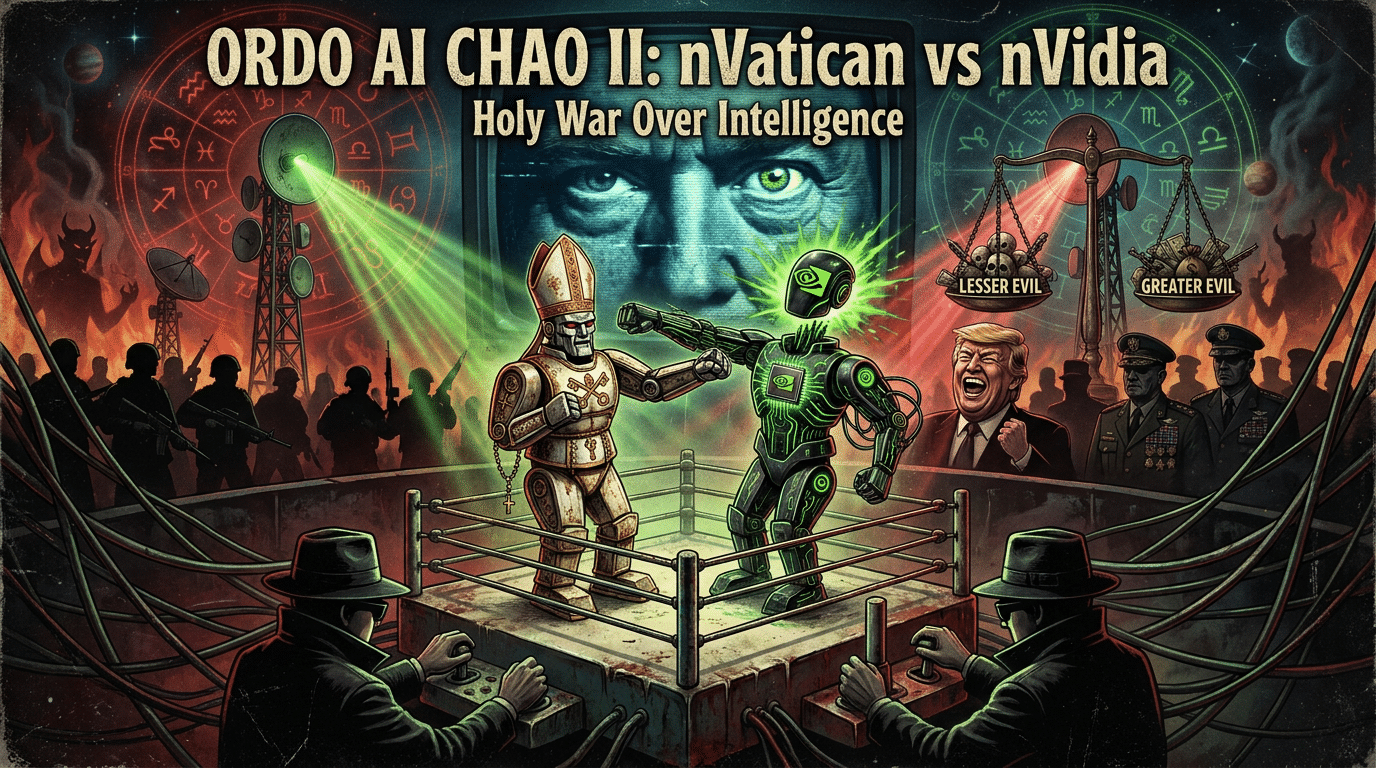
Lost in the Bedroom — The man who handed out presses
In 1526 William Tyndale did what the Church forbade. He put scripture into plain English and printed it abroad. Copies were smuggled into England in bales of cloth, and anyone who could read could now interpret the word for themselves, without a priest in between.
The response came from the top. Cardinal Wolsey had already presided over the burning of Luther’s books at St Paul’s, and now Tyndale’s New Testaments were bought up and burned at St Paul’s Cross. At Oxford, Wolsey founded his great college “to put learning against learning”: sponsored scholarship to counter the unsponsored kind. A vicar of Croydon put the establishment’s fear plainly: “We must root out printing, or printing will root out us.”
Five hundred years later another man was handing out presses.
Jensen Huang’s heresy
Jensen Huang built the chips the AI age runs on. Late in his tenure he went further than any chip-maker needed to: he set out to make sure no one had to ask permission to build intelligence.
- He gave away the models. NVIDIA’s Nemotron family of open-weight models was released free to “download, use and modify without getting permission or paying Nvidia.” In October 2026 he told a Berlin audience that open models, customized, can beat the frontier: the closed labs’ crown jewel, matched by anyone with the weights.
- He preached sovereignty. “Every country needs its own sovereign AI — to produce intelligence rather than import it.” Every nation, in its own language, on its own hardware, with its own values. That’s Tyndale’s vernacular Bible scaled to the planet.
- He fought the walls. He called export controls “a failure,” lobbied Washington to keep selling, and urged lawmakers to avoid “premature restrictions” that would push open AI offshore.
- He refused the priesthood. As the closed labs and their allied safety groups argued that frontier AI was too dangerous for open release and should be licensed, audited and centrally held, Huang resisted.
Yes, every open model and every sovereign data center sold more NVIDIA GPUs. Printers sold books too. Selling presses doesn’t make you any less the person who put them in everyone’s hands.
The powers that prefer one pulpit
Each of the old powers had reasons to want the presses back under license:
- The state saw chips as weapons and openness as leakage.
- The closed labs saw open weights eroding the moat they’d spent billions to build.
- Rome spoke most plainly. In May 2026 Pope Leo XIV’s encyclical Magnifica Humanitas warned against the “technocratic paradigm and digital power” and called for robust AI
regulation. On 29 September he went further and rebuked Jensen Huang by name for resisting AI safety rules, urging world leaders to set common limits.
Huang answered politely: “We all care about the same thing.” Then he kept shipping open models.
Not refuted. Removed.
The most important argument of the century is about who owns intelligence: everyone or a licensed few. It was never won or lost on the merits.
It was lost in a bedroom.
Huang had the chips, the money, the models and the stage. He had a Pope rebuking him by name and Washington lining up export walls, and he kept shipping open weights anyway. None of them could beat his argument. None of them had to.
On 12 November 2026 he resigned “effective immediately” after reports of affairs, one of them with a woman U.S. intelligence concluded was a Chinese asset. The oldest trick in the spy’s book is the honey trap, and it beat the most powerful man in the newest industry on Earth.
That’s the bitter part. Humanity’s course was being fought over, and its leading champion of openness handed his enemies the knife himself. No conspiracy was needed. Powers that wanted open AI licensed, walled and centralized didn’t have to engineer his fall. They only had to be ready when he gave it to them, and they were:
- Within four days: new chip restrictions from Washington, with bipartisan bills close behind.
- Within a week: the press asking whether NVIDIA’s open-model program survives him.
- The market: consolidating toward the closed few. In David Sacks’s words, the ouster “does nothing for AI safety… it’s concentrating the market.”
Tyndale was undone by a false friend. Huang was undone by his own appetite. In both cases the cause was never answered; it was only made easier to ignore.
When a movement rests on one man, his weakness becomes everyone’s.
You cannot un-print a book
Tyndale was strangled and burned in 1536. His last words were reportedly “Lord, open the King of England’s eyes.” Within three years Henry VIII authorized the Great Bible, and most of its New Testament was Tyndale’s translation. They burned the man and kept his work.
The same will happen here, because weights can’t be recalled. Every Nemotron download, every sovereign model and every open checkpoint on every hard drive is already out of the box. The man can be removed. The presses he handed out can’t.
What remains is to make sure the next fight doesn’t hinge on one man’s weakness. Openness has to be built into structures, not carried by a champion:
- Open weights with verifiable provenance: anyone can run a model and check its claims.
- Plural compute: many chips, many fabs, open instruction sets.
- Antitrust aimed at fusion of chip, model, interface and regulator.
- Local-first AI: an answer box on your own hardware that nobody can quietly retune.
Distributed structures don’t have bedrooms.
They burned Tyndale and kept his translation. Removing Huang won’t recall his models either.
────────────────────────────────────────────────────────────────────────────────
Sources (link inline before publishing):
- Part I: wp.brenden.com/ordo-ai-chao-learning-against-learning-…
- NVIDIA Newsroom, “NVIDIA Announces CEO Transition” (12 Nov 2026)
- NYT and Bloomberg live coverage of the resignation (12 Nov 2026)
- CNBC, Nemotron open-model release (11 Aug 2026)
- Forbes, “Jensen Huang Says Open Models Can Beat The Frontier” (26 Oct 2026)
- Huang, World Governments Summit, on sovereign AI (via Forbes/BISI)
- Tom’s Hardware, Computex 2025, “Export control was a failure”
- vatican.va, Magnifica Humanitas (15 May 2026)
- IBTimes, CryptoBriefing and Fortune on the Pope–Huang exchange (Sept–Oct 2026)
- Washington Post, chip-rule tightening (16 Nov 2026); TechCrunch on the open-source program after Huang (12 Nov 2026)
- ZeroHedge/Sacks remarks (Nov 2026)
- British History Online, Croydon (“root out printing”)